Weekend Update #178: Two Weeks Into The Russian Spring Offensive And The Ukrainians Have Gained Territory
The Ranged War and the Ukrainian Destruction of Russian Baltic Oil Terminals; Ukraine Helps The Gulf States

Hi All,
Before I start this update, I wanted to bring to the attention of those who might have missed it, that on Thursday March 26, I held a Substack Live with Bohdan Zhelobchuk of Come Back Alive.

Bohdan works as part of CBA’s team developing Unmanned Ground Vehicles (UGVs) which are becoming increasingly ubiquitous on the battlefield. He went into fascinating depth about their roles, discussing the delivering of supplies to forward troops, the evacuation of wounded soldiers and even UGV’s holding sections of the line with no human soldiers present. Considering the speed and importance of their adaptation and development, we might soon be seeing entire engagements of UGVs fighting UGVs.
Needless to say, such vehicles are crucial to the saving of Ukrainian lives. If you do want to support CBA’s efforts in this regard (or any other) you can make a donation to them through this link. I really hope you consider it.
One of the things that makes UGVs so important in saving Ukrainian lives, as Bohdan explained in some detail, is that the battlefield has continued to become increasingly transparent and deadly for human beings. UAVs, UGVs and other systems now are ranging further and further and it is becoming much more difficult to hide, even many miles from the front. It is why the Ukrainians are determined to keep the number of infantry at the front at the smallest number possible. For the Russians, that seems impossible as they are desperate to advance and as particularly manned vehicles cannot survive for long, they need more and more human beings to try and move forward. That, however, looks even more difficult this year (see below). We are now almost two weeks into what some have labelled the new Russian Spring Offensive, and the Ukrainians have stopped the Russians dead, literally.
Other key stories this week include a discussion of the ranged war, in particular the Ukrainian campaign against Russian oil terminals on the Baltic. It makes an interesting comparison to what the Russians are continuing to do with their ranged campaign. And finally, Ukrainian expertise is showing its values to other states at war. Hopefully Europe gets the message.
Two Weeks Into The Russian Spring Offensive And The Ukrainians Have Gained Territory
Starting around March 17, there was a massive spike in Russian ground attacks in Ukraine. According to General Syrskyi, in a four day period near the start of the offensive, the Russians launched more than 600 different assaults across the front.
And we saw a range of Russian efforts, including in some instances attempts to send groups of armored vehicles into the attack. One Ukrainian corps reported that one series of Russian attacks included as many as 500 vehicles. These kinds of attacks even as late as last year, might have resulted in small but perceptible (if strategically irrelevant) gains for Russian forces.
This year, however, something rather different seems to have happened, at least to begin with. Russian gains have been in practical terms non existent, both during the last two weeks when they have been attacking, and before. Leading into March, as I am sure many of you have heard, the Ukrainians actually recaptured about 100 square miles of land.
When the Russians attacked this year, they have run into very well prepared Ukrainian defenses. There were minefields, fortifications, and, a growing and increasingly effective Ukrainian defensive drone wall.
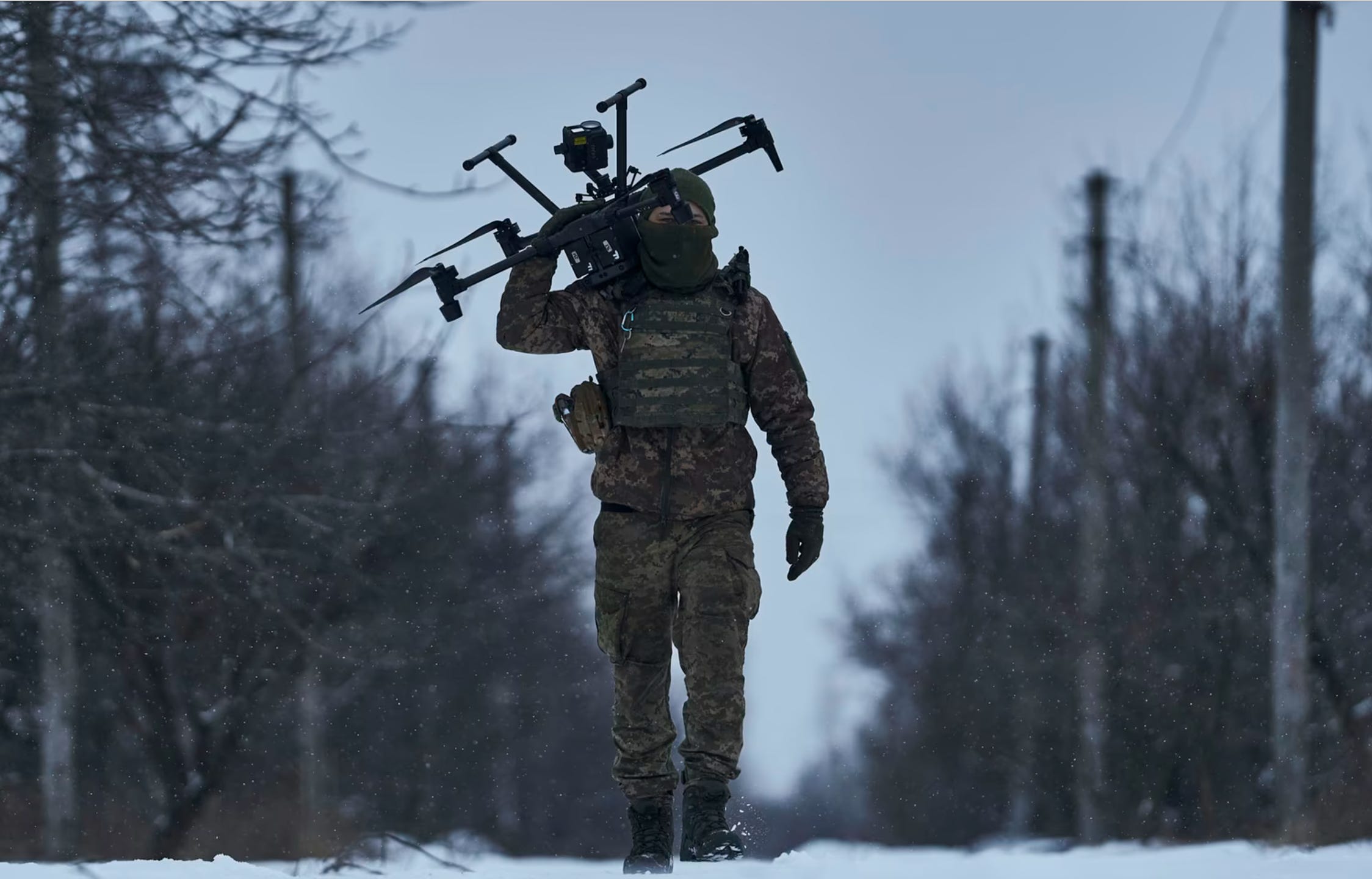
Most interestingly, is how little land the Russians seem to be able to capture. During the first week of the Russian Spring Offensive (March 17-24) the Ukrainians reportedly regained even more land than the Russians seized. Now it was a tiny amount, about four square miles, but it is notable that it happened with the Russians trying to seize the initiative.
Btw, General Syrksyi claimed that so far, since the Ukrainians started their attacks a few months ago, that they have regained overall 470 square kilometres/181 sqare miles from the Russians. This might be somewhat overstating what has happened, but it is notable that the Ukrainians are claiming it.
Many factors seem to be interacting in the stopping of the Russian offensive. One thing that is getting more and more mention is the decreasing quality of the Russian soldier. This should not be surprising (in some ways I would have expected it to have happened sooner) but the enormous losses that the Russians have suffered, and their insatiable need to send more and more forces into the attack, seems to be reaching a point of diminishing returns.
Vladyslav Urubkov, head of the military department at our good friend Come Back Alive, gave an interview in which he discussed how the “low morale and poor training” of Russian troops was proving to be a major problem with the Russian attacks.
And this makes sense. Even in a closely guarded society such as Russia, news of the massive casualties, miserable conditions in the army, and poor training has been circulating. To actually raise soldiers, the Russians have to rely increasingly on those who have no other option and probably understand that they are signing up for close to certain death or serious disability. And those soldiers the Russians do raise seem barely trained. There were reports in the last week that the amount of training that Russian soldiers are getting before being sent to the front is down to one week.
And after their extremely quick training, these soldiers are sent forward quickly to make bloody assaults for little/no gain. The tactics are resulting in such high losses and low morale that the extremely nationalistic Russian milblogger community is now regularly bemoaning the present state of the Russian army. Btw, the casualty rates the Russians are suffering make this all plausible. While the week before saw two higher days, Russian casualties over the past week averaged comfortably over 1000 per day.
Here is the daily reported breakdown of Russian personnel losses as judged by the Ukrainians:
March 28: 1,300 casualties
March 27: 1,000 casualties
March 26: 1,210 casualties
March 25: 1,220 casualties
March 24: 890 casualties
March 23: 970 casualties
March 22: 940 casualties
The issue with poorer quality soldiers getting less good training, is that once a ship heads in that direction it is very hard to turn it around. The losses and frustrations on the battlefield will continue to be a disincentive (to put it mildly) dissuading those from serving, and that means those men that somehow end up in the Russian army will be needed at the front sooner and sooner—which means they will get even more degraded training. You can see the vicious cycle developing.
Btw, this was one of the reasons those who for two years were clamoring for Ukraine to draft more unwilling people for the army and send them to the front were being so dangerous. Compelling unmotivated soldiers to serve in such a horrible battle area could make things worse. It is far better to reform the military you have (the Ukrainian military was/is in need of reform) and adjust to the technological realities of the battlefield than generate soldiers through force and send them to the front. Here is a piece from late 2025 which tried to walk readers through just this dilemma. The Russians decided to throw troops at the question, the Ukrainians have tried to adapt.

So, two weeks or so after the start of the new Russian Spring Offensive, Russian advances are declining compared to 2025 and Russian losses are so high that training and morale are suffering. Ukraine has a chance to put the Russian army into a spiral of decline out of which it will be hard to pull out. If only the US had not switched sides…
The Ranged War and the Ukrainian Destruction of Russian Baltic Oil Terminals
There were some major ranged attacks by both sides over the last week. The Russians on the evening/morning of March 23-24 launched the largest ranged bombardment of the war. They first did an overnight attack with 426 missiles/drones and then followed that up a few hours later with a rare mass daytime attack with 556 drones and missiles. This combined total of 982 drones and missiles is the highest that the Ukrainians have ever recorded.
There seems to have been some method in the staggering of the attack. Much of the first wave was directed at Kyiv, perhaps to draw Ukrainian attention to the east and centre of the country while using up anti-air ammunition. The daytime attack was then focussed more on the west, with some notable strikes in Lviv where a number of historic buildings were hit.
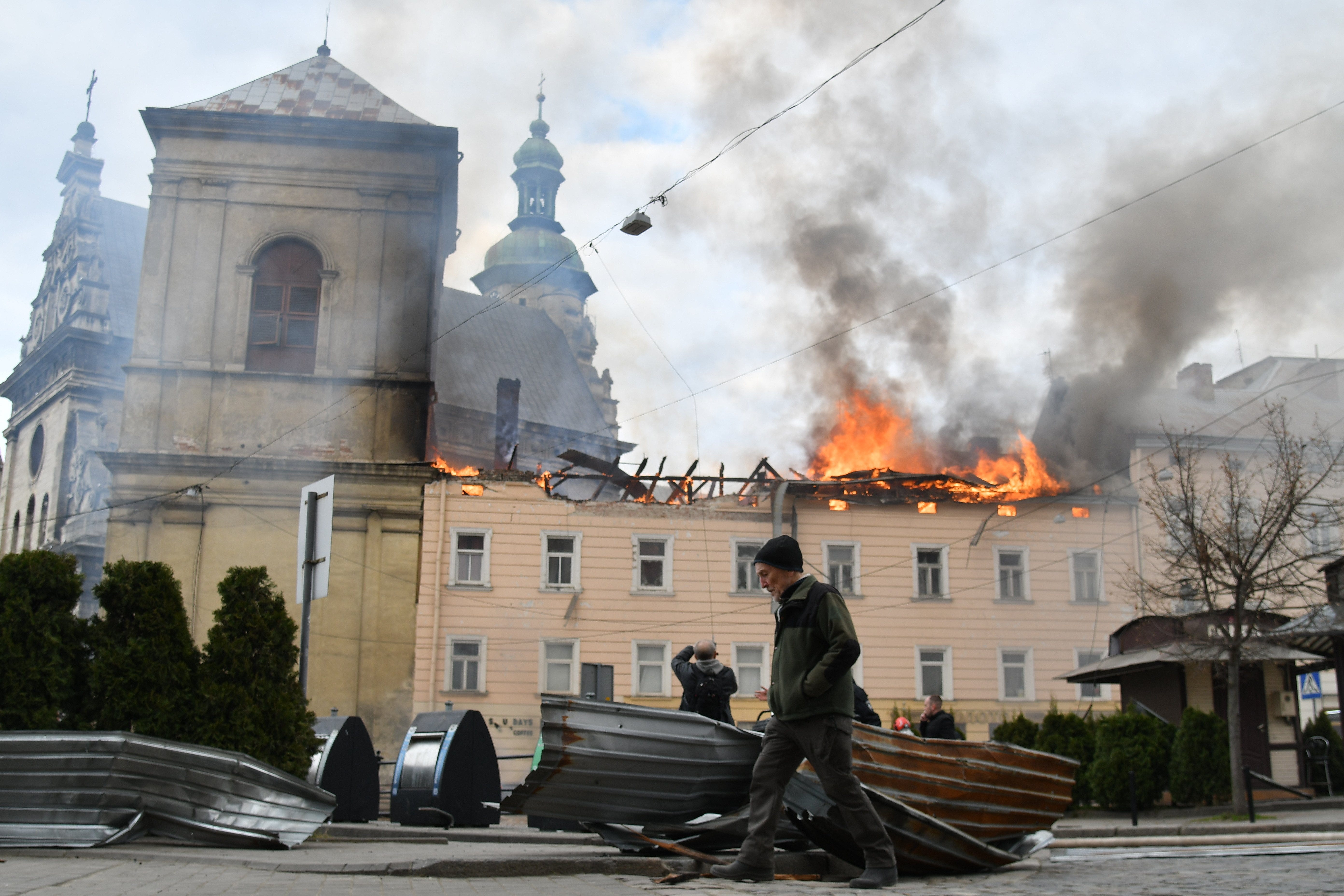
The purpose of the attack seems similar to most Russian ranged attacks of the last winter. Many of the Russian attack systems were aimed at Ukrainian power generation, to break the Ukrainian civilian will and to damage the economy. Undoubtedly another reason for the attack was to further run down Ukrainian stocks of Patriots, as it is widely believed the US might reduce or even shut down the supplies of new Patriot missiles because of the Iran war.
So the Russians were doing what they have been doing. On the other hand, the Ukrainians opened up a new set of targets this week, which was very revealing. They attacked the same facilities three times (as of now) in five days, and these were the main Russian oil export facilities on the Baltic, Primorsk and Ust-Luga. Here is a list of the attacks.
March 22–23: Drones struck the Primorsk oil terminal, igniting a fuel depot and damaging berths and tankers.
March 24–25: Long-range drones hit the Ust-Luga port, severely damaging the terminal, oil storage tanks, and related installations.
March 26–27: Coordinated drone strikes hit both Primorsk and Ust-Luga again, causing further fires and destruction to the oil-loading infrastructure.
All one can say is that this is a great indication that Ukraine is now going after the whole Russian production/exporting system and that Ukraine now understands that it takes repeated attacks on the same facilities to put them out of action. I put together this piece on Friday which delved into why this is so important.

Reports are that because of these attacks (and others) Russian exports of oil could be down by as much as 40%. Moreover, Russian exporters are on the verge of declaring Force Majeure, to many of their customers. Declaring FM is a legal shipping declaration that contracts cannot be fulfilled because of special circumstances. For the first time in 2026 (they did this in 2025 for a while) the Russians have declared that they will temporarily halt the export of all refined fuel products. That ban goes into operation on April 1.
Had Trump not started the Iran War, these Ukrainian attacks would have been a major blow to the Russian war economy and it is conceivable that Russia would have faced a hard currency crisis. However, oil prices are up by at least as much as shipments are down, and moreover oil prices look to be heading even higher, at least for the short term.
At a minimum, however, Ukraine is going to seriously limit the Trump windfall for the Russians. And, maybe more hearteningly, the Ukrainians are showing the ability to plan for and execute intelligent systems warfare. These are not the only signs. The Ukrainians are increasingly trying to threaten/control the air space around Moscow.
So the Russians are doing what they are doing (which has effect) while the Ukrainians are improving. There are certain echoes here to what we are seeing on the land war.
Ukraine Helps The Gulf States
I was first going to make the last story about how the Ukrainians admitted that the Trump administration is trying to bully them handing over the Donbas to Putin. Zelensky came right out and said it publicly this week. That was certainly a major story, but then I thought it would be the least surprising/interesting new development for readers of these updates.
Trump is acting like a Russian agent! Shock, horror, who would have imagined!
On reflection a far more important story this week was that the Ukrainians signed a number of defense agreements with US allies in the Gulf region, in particular Saudi Arabia, Qatar and the UAE. These agreements will see Ukraine work with them on the development and production of systems to protect against drone attacks. These states are all allies of a sort with the USA, and have based their defense in the past overwhelmingly on cooperating with America. However all three of them have concluded that the USA is not the best partner for this vital work. Ukraine definitely is. Here is a list of the deals that were announced, with some details.
Saudi Arabia
The Agreement: On Friday, March 27, Ukraine and Saudi Arabia signed a defense cooperation agreement ahead of Zelensky’s meeting with Crown Prince Mohammed bin Salman.
Key Focus: Ukraine will use its technological experience to help Saudi Arabia bolster its defenses against ballistic missiles and one-way attack drones.
Future Scope: The arrangement establishes a legal and operational foundation for future defense contracts, mutual investments, and joint technological cooperation.
Qatar and the United Arab Emirates (UAE)
Qatar: On Saturday, March 28, Ukraine and Qatar officially signed a 10-year defense agreement. This comprehensive pact covers counter-drone measures, cybersecurity, artificial intelligence, and the establishment of joint defense production factories in both countries.
UAE: Also on Saturday, following talks with Emirati President Mohamed bin Zayed Al Nahyan, Zelensky announced that Ukraine and the UAE had agreed to cooperate on security and defense. Specialized teams are currently finalizing the specific details of that arrangement, which is expected to follow a similar 10-year framework to that agreed with Qatar.
So when it comes to one of the most pressing military threats facing states these days, the USA is not the preferred partner of choice, nor are any of the traditional European defense firms—it is the Ukrainians. Let that sink in. Ukraine is now a world leader in one of the most important strategic capabilities all states face.
It highlights something that I really hope more and more Europeans realize. People need to stop looking at Ukraine simply as a state that needs help and support. Ukraine is transforming in front of our eyes into a world leader in military tech. It is the best example of the point I tried to make a few weeks ago, that Europe needs Ukraine as much as Ukraine needs Europe.

Now, there is still a long-way to go on this. This week also the Atlantic published a story about the slow pace of adaptation in the European defense industry.
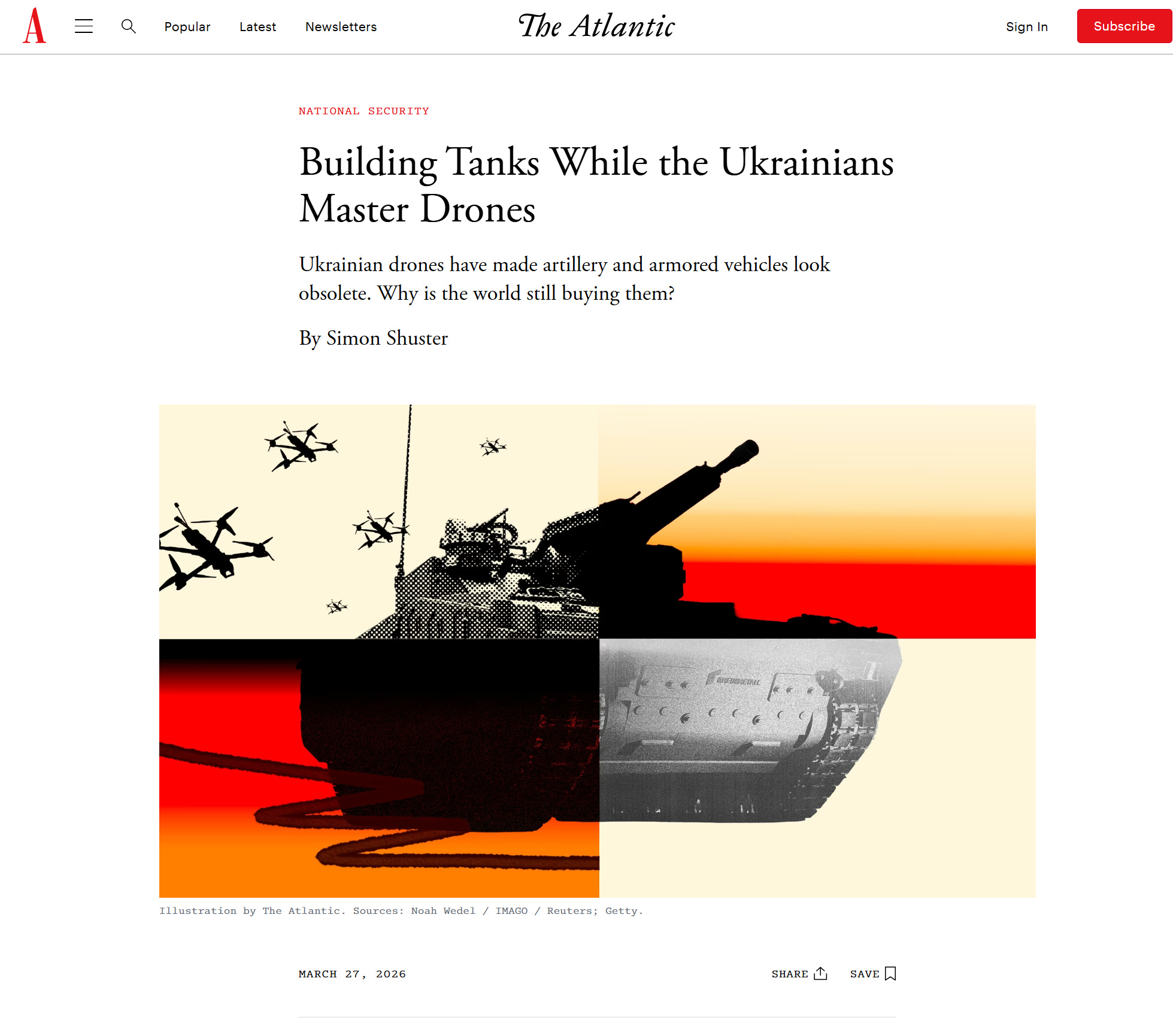
To many, it still seems like warfare is stuck in 2021 thinking, with stress on heavy, expensive and over-engineered tanks and fighting vehicles. The CEO of Rheinmetall, Armin Papperberger, made a statement in this article that is a candidate for one of the most foolish of the war so far.
“…when I asked the CEO of Rheinmetall what that could mean for his business model, he bristled. “Who is the biggest drone producer in Ukraine?” Papperger demanded. I listed the ones that I had visited in Kyiv two weeks earlier, Fire Point and Skyfall, which make hundreds of thousands of drones a month for the Ukrainian armed forces. “It’s Ukrainian housewives,” Papperger said of their factories. “They have 3-D printers in the kitchen, and they produce parts for drones,” he said. “This is not innovation.” “
Is there a way to type a primal scream? If so, I would be doing it.
Ukraine is creating weapons for a fraction of the cost, which can destroy/damage the legacy systems upon which defense companies have constructed their past. These companies can either pretend like everything is fine, or they can adjust. They might watch what is happening as states at war turn for help from the Ukrainians and start adapting.
Europe has a chance—please take it.
Have a good rest of the weekend everyone.
First of all, how nice of the Russians to finally admit Ukraine is a force majeure...
Second, Rheinmetall's business plan is built upon making heavy armour, artillerie and shells. We all know that heavy armour is not obsolete, if that is the case mr. Papperger tries to make, in a rather atrogant way I would say. No, Ukrainian housewives are not playing with LEGO, they're part of an innovation chain, a result of out of the box creative thinking.
Just as logistics, project management is an overlooked skill in military innovation. The Ukrainian adaptation and innovation cycle for AI and drone warfare is unmatched.
The Ukrainians took IT engineering and project management to a different level and have succesfully integrated into military structures. It's lean and mean, PRINCE2 on steroids. It's also a skill mr. Papperger doesn't seem to grasp, nor does he see the perfect sense it makes in modern warfare. German industry is famous for it's quality and standardization. But that also takes time, loads of time and money. And it's precisely this the Ukrainians don't have. So they found another way, perhaps even better. That's not foolish, that's astounding.
Thanks for this heartening update ! At the pace things are going,Ukraine may be invited to join NATO before it becomes a member of the EU. Trump will never endorse that of course, but by November and the mid-terms, he may be sufficiently weakened to be overridden by Congress and the other member states.
Wishful thinking ?