Midweek Update #10: Little Changes In US-Iran, Potentially Lots With US-China
What Did The Bombing Campaign Accomplish?; Will China Save The US With Iran?

Hi All,
Well another week with lots of statements, denials, threats and bluster, but as it has always been since the end of March, no substantial change. If I would say the most interesting thing is how now the narrative of Trump really wanting a way out is finally being widely accepted. There were interesting stories in the last few days about how Trump was bored of the war and looking for a way out, or how he was politically being hurt by the war and flailing around. Of course that has been the case for more than a month and a half, as I have tried to communicate. This was how I started Midweek Update #3 on March 25.
Well midweek update #3 is here. There is a chance that there will not be a 4th of these, but it is not a likely one. That is because while the Trump administration, and the president specifically, is keen, almost desperate, to get out of this war that it/he has started, they still cannot guarantee that Iran will let them leave.
The exact same dilemma laid out in late March is still in play in Mid-May. Trump wants out, but Iran will not give him the terms he feels he needs to declare victory and get out, and so he is waiting and hoping that the Iranian government feels enough pressure to soften their position. That is really all there is here—nothing else is happening.
And you get all this spot-on analysis for free! ;)
Two more stories of importance really emerged this week. One of the reasons Trump is stuck is that waiting is helping Iran recover militarily and also intelligence reports are saying that the original bombing campaign seems to have damaged far less of the Iranian military than was claimed at the time. And they have had a month and a half to recover. Restarting military action by the US is therefore more risky. Finally, the US is so stuck in Iran, and has been so hurt by the war, that the Trump administration seems to be hoping that China saves them. That is a depressing commentary on the way the US is weakening itself.
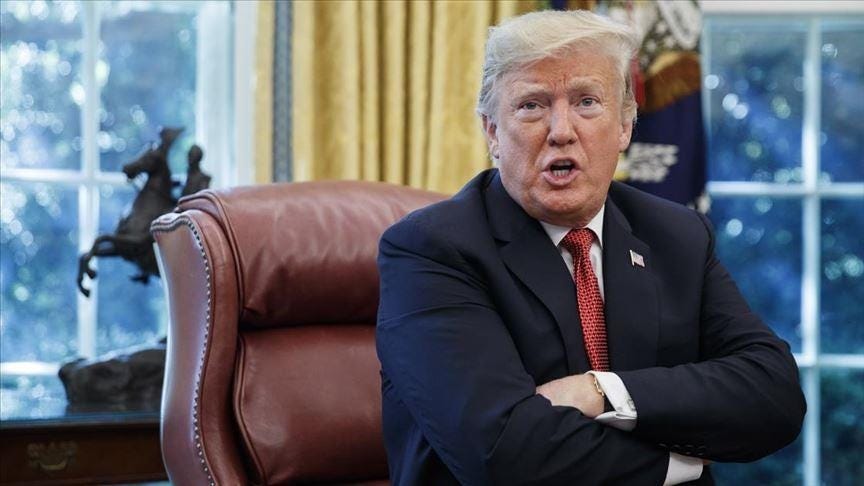
Little Changes With US-Iran
The only thing that seems to have changed over the last few weeks is that Trump’s threats are getting a little less extreme. After weeks of trying to frightening the Iranian regime and impress his US supporters by talking about committing historic war crimes against the Iranians, to destroy their bridges, power plants, indeed their national life, the threats are getting a touch more coy and do indicate that he really is running out of options.
That is what we saw over the last few days. As a refresher, on Friday Trump said he was expecting a response from the Iranians to a US peace proposal. The Iranians, who some say believe that they have the upper hand in the negotiations because they are willing and able to outwait Trump, did not actually reply to the US until Sunday. This Iranian response showed no softening in the Iranian regime’s position at all. It left Iran in control of the Strait, with sanctions over, assets returned, still in control of their nuclear material, etc. etc. Here were the points highlighted Monday.
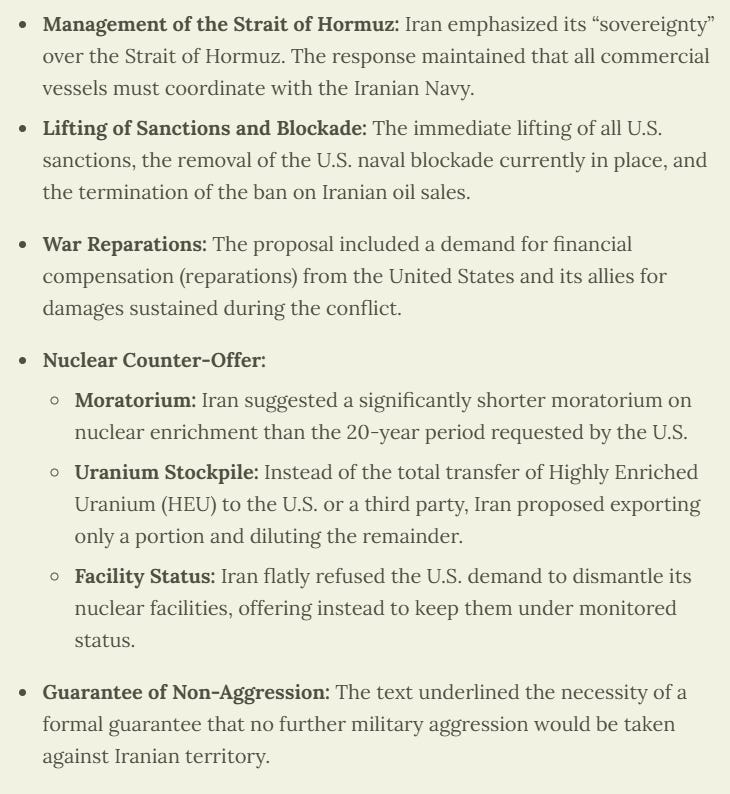
Trump is smart enough to know that he cannot throw in the towel to those terms, so rejected them angrily on Monday and Tuesday. He still needs something to be able to sell to the American people to back up his constant claim that he has won the war and, as he has for weeks, really thinks it must be something on Iran’s nuclear program. In a comment to the press yesterday, Trump once again made that his key demand—even saying he was not worried about the economic impact of the war on the US (an outright lie as he is very worried) because of the threat of Iranian nuclear weapons.
“I don’t think about American financial situation — I don’t think about anybody. I think about one thing: We cannot let Iran have a nuclear weapon.”
I suppose in some ways there is a change in that he is using more coy language than before. When he got the Iranian terms he did not threaten to bomb Iran back to the Stone Age (though maybe we will get that again soon), saying instead that the Iranian response was “totally unacceptable” and the now the ceasefire was on “life support”.
Of course it is on no more or less life support than it has been on this whole time. That is just rhetoric. If Trump believed he could get much better terms by restarting military activity, he would. However, the military options, if anything, probably look a little worse now. He has given Iran a month and a half to restore its military assets, get more from Russia and possibly China, devise better defenses, work out new attack plans, etc. We can also assume the Iranian regime has more control over the situation than before.
And as the second story shows, US intelligence believes that the Iranian military was less damaged in the initial strikes than claimed. It is a mess.
What Did The Bombing Campaign Accomplish?
The Trump administration has spent a massive amount of time telling the American people how amazingly destructive and effective the US bombing campaign before the ceasefire was. On April 7, when Trump declared the ceasefire, he stated directly that the Iranian military had been destroyed, that the US had “already met and exceeded all military objectives” and had achieved “total and complete victory. 100%. No question about it”.
Secretary of Defense Hegseth was even more explicit about how long it would take the Iranian military to rebuild. He said: "Epic Fury decimated Iran's military and rendered it combat-ineffective for years to come."
Well, turns out that years might have been days, or to be honest, no time at all. US intelligence reports have been leaking lately, and they do not paint a picture of an Iranian military that has been damaged in the way that Trump and Hegseth are claiming. The Washington Post published a story five days ago which said Iran was in a strong position to outlast US pressure, partly because its military was in better shape than Trump administration sources were claiming openly. In particular, when it came to its mobile missile and missile launch capacity, a key part of the Iranian military threat, the reports are the 75% of these remain intact.
The New York Times backed all this pessimistic reporting up yesterday by publishing a very alarming story from the US perspective about both how much of the Iranian military was left intact by the strikes and moreover, how things have improved for Iran since. Here is how that article started.
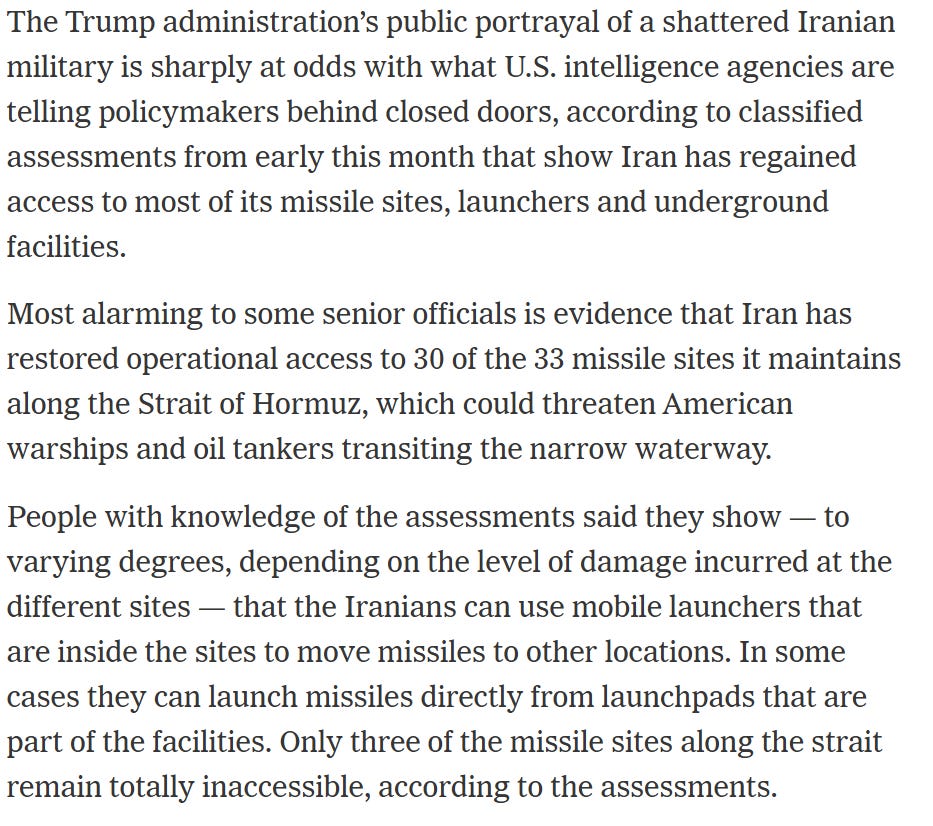
The depth and pessimistic nature of these reports were reportedly why even Republican members of Congress were pushing back yesterday on the administration.
So the Iranian military might not have been so damaged by US strikes as claimed and has now had a period to reconstitute itself—particularly in strategic areas such as the Strait of Hormuz. Every day this continues it means Trump restarting military action becomes a riskier choice.
The US military, as I said Monday, has demonstrated worrying signs of failing in this war. The rot might be worse than expected.

Will China Save The US With Iran?
One of the possible reasons the Iranian military came through the original bombing in better shape than was claimed/expected by the Trump administration was that the Iranians were helped by the Chinese. For instance, it has been reported that Chinese-provided radar and masking technology helped Iran conceal its air defense systems from U.S. sensors during the bombing phase of the war.
There have also been a host of other reports about how China continued to support Iran during the bombing, and maybe even increased its aid. This included a detailed Financial Times report on Chinese radar aid for Iran which could have been a big help in Iranian targeting of US resources.
Certainly this war seems to be playing entirely into China’s hands, exposing all the weaknesses of the US position, forcing the US to display its military shortcomings, and running down strategic US stocks, further fraying US alliances, etc. It is therefore a tad ironic that the Trump Administration is now hoping China helps them get better terms from Iran. In testimony to Congress yesterday, Hegseth claimed China has "a lot of leverage" over Tehran, specifically noting that China "buys a very large percentage" of Iranian oil. This, according to him, made China a possible partner to help with Iran—the phrase Hegseth used was that China might be “helpful”.
Quite why the Chinese will bail the US out of the mess it is in was not stated, but the reality might be known in the next few days. Trump is off to China, and there is a very good chance that he basically sells the farm to the Chinese to try and win Xi over. Trump is going to China as a supplicant not a dominant power, and the Iran war is a key part of that. The fact that the US now hopes China helps them tells you everything you need to know about the state of the relationship between the world’s two largest powers, and specifically how much weaker the US has become because of this war.
The US should be learning some hard lessons about both power and war. I am not sure that it is however.
Germany took the offensive initiative of occupying Norway the 9th of April 1940. They sent the battle cruiser Blücher to spearhead the landing forces in Oslo. Norway was really not prepared for an invasion, except at Oscarsfort in Oslofjorden, manning three 28 cm cannons and a torpedo battery.
The Sound of Drøbak (strait really) is only 500 meters across, so when Blücher came steaming at 4 AM, a corageous Norwegian colonel took the defensive initiative to fire at the warship. Blücher sank at around 6 AM.
Becides the obvious lessons of navigating hostile straits, are there others? Well, even after pumping around 1,000 metric tons of heavy bunker oil from the wreck, it still seeps oil into the fjord 86 years later. A grim reminder of the long-lasting environmental consequences of modern war.
As Magyar (birdman) himself points out, the Russians pile Ukraine with plastics, toxins, heavy metals, potentially contaminating Ukranian soil for centuries to come.
When Hegseth said "Epic Fury decimated Iran's military" did he mean it in the original Roman sense of "1 in 10" has been destroyed?