Weekend Update #195: The Worst Week Becomes Much Better (But Not The Best)
Major General Mykhailo Drapatyi; Wildberries and Azov

Hi all, last week was a momentous one for Ukrainian democracy, and possibly for how the war develops over the next period. After two and a half years, overall command of the Ukrainian army was transferred from General Oleksandr Syrskyi to General Mykhailo Drapatyi. The move was greeted with uniform praise from Ukrainians I know and trust and that is definitely the lead story of the week. Of course, the trigger for this change, the removal of Defense Minister Fedorov, is still the reality as of this update being written. There is every indication that President Zelensky is trying to ride this crisis out by keeping Fedorov out of his old post. If that remains the case, it cannot be called the best week.
Btw, if you want to hear more about how the replacement of Syrskyi by General Drapatyi was viewed in Ukraine, Shaun Pinner and I held a substack live on the question the day after the announcement.
The decision making in Ukraine will be the focus of the first two parts of this update. First will be what happened last week in terms of overall command (and what did not), and where we go from here. Note, this is far from being settled.
Next, there will be a section on General Drapatyi himself, as I am sure he will be unknown to many of you. The last section is a quick rundown of the Ukrainian strike campaigns this week, with particular mentions about the attacks on Wildberries warehouse and in the Sea of Azov, both of which are ongoing.
Finally, I just wanted to give you a heads up that the next Substack Live with Come Back Alive will happen this Thursday at 16:30 Ukraine Time/14:30 UK time and 9:30 US East Coast time. The focus will be on the human experience of this war, training and morale. I will be talking with Ivanna Ryzhkova, a combat medic who has experienced the worst of this war and now works with CBA’s training centers.
Ok, let’s get to the main event.
The Worst Week Becomes Much Better (But Not The Best)
Sometimes we forget that democracies have certain inbuilt advantages in war. They often screw up badly, start slowly, prepare inefficiently, etc, but democracies can also be better at adapting and channelling societal abilities and commitment. This week we saw the benefits of a democracy. Pressure from Ukrainian civil society told on Ukraine’s political leadership.
President Zelensky clearly did not expect the reaction he received after the removal of Fedorov. There were protests across Ukraine that actually grew in intensity up until last weekend, and they were directed not just towards bringing back Fedorov but also towards replacing General Syrkyi as chief of the General Staff.
Now, Syrskyi divides opinion like no one in Ukraine I have heard discussed—and I mean that. Someone like Yermak does not divide opinion, he is generally distrusted and was believed to be a problem. Syrskyi, otoh, has always had his strong defenders as well as his critics. I summarized both views when he was appointed to replace General Zaluzhny in early 2024.

As overall commander, Syrskyi continued to divide opinion—maybe even more strongly. While he continued to have his backers, there was also a great deal of disquiet with his overall command, his tendency to micromanage, his “Soviet” military outlook, his focus on tactical gains over strategic success, and his willingness (especially before 2026) to tolerate very high casualties.
I am summarizing here.
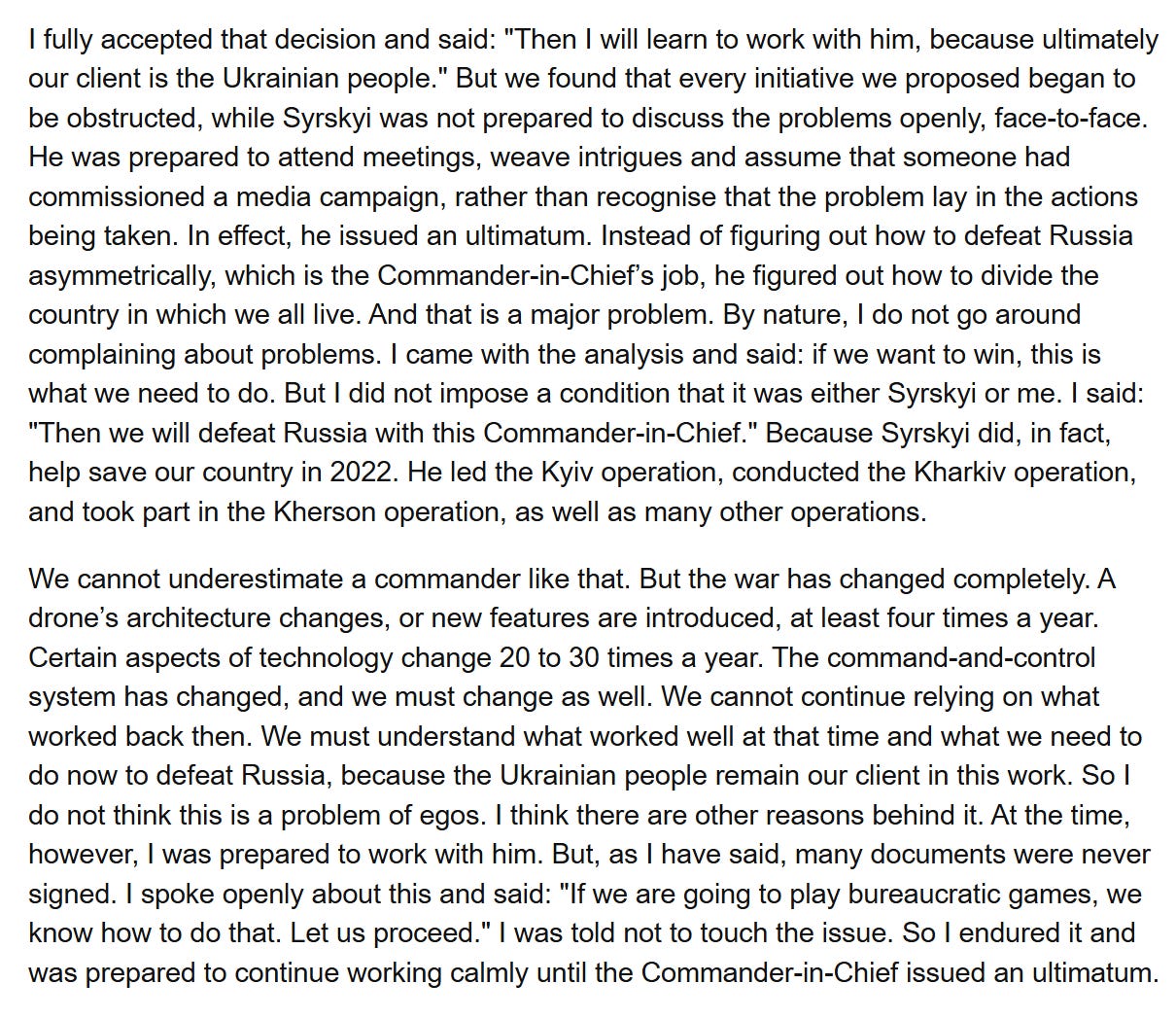
And clearly he and Fedorov had a very rocky relationship. In the fascinating press conference that Fedorov gave after his dismissal, he accused Syrskyi of “splitting the country”.
Fedorov basically said Syrskyi was dividing not just the country, but the military. Units the general liked were favored while others were discriminated against and deprived of life-saving equipment. This seems to be particularly the case when it came to the supply of drones, and Fedorov went into detail about that—note the word “loyal”.
Supplies do not flow through the corps. The supply problem is fundamental. Over the past five months, we procured more drones than in the whole of last year, yet most units did not feel the difference because distribution is handled manually. If you are loyal, you receive supplies; if you are not, you receive nothing. As a result, units cannot plan their future.
Later in the press conference, Fedorov went into detail about his personal, working replacement with Syrskyi. Apologies for the length of the excerpt, but the detail is important.
It might be said that Syrskyi had overplayed his hand. When Zelensky was confronted with a binary choice (Syrskyi or Fedorov) and chose the General, Syrskyi actually found his position weakened. While Fedorov was in the defense ministry, no one wanted to rock the boat. However with Fedorov out, Syrskyi became the focus of popular anger.
Things were made even worse when Syrskyi tried to pretend that he was surprised people were saying he and Fedorov were not getting along. As the tide turned against him, Syrksyi gave an interview saying that he was “surprised to learn that we have a conflict”. In the end, however, Zelensky decided Syrskyi had to go, and on Tuesday the General was out and Drapatyi was in.
Of course, that was only part, and in some ways the lesser part, of what many Ukrainians wanted. This started with the dismissal of Fedorov and getting Fedorov back as Defense Minister remained a key priority. That, for now, seems a far greater ask than changing military command.
What we know is this. Zelensky and Fedorov have communicated multiple times over the last week, and Fedorov has been offered some grand-sounding, but primarily advisory, positions. The most prominent of these was “Deputy Prime Minister” with a remit to advise on military/technical matters. Fedorov, however, will have none of it. His experience over the last few years has convinced him that: “only three positions in the state - in addition to soldiers on the battlefield - which determine the course of the war: president, defence minister and commander-in-chief.”
So we are left with this stand-off. Zelensky for now wants to stick with his new choice for Defense Minister, Evgeniy Khmara. As Khmara has not yet been approved by parliament, he is listed as “acting” defense minister at present—so that gives everyone some wiggle room.
Fwiw, I have heard positive things about Khmara. He has a great deal of military experience and before being appointed to this job, had been serving as Budanov’s replacement at the head of Ukrainian strategic services. It is also worth noting that he is being touted as more similar to Fedorov than Syrskyi.
How this will play out is still up in the air. One reason Zelensky seems determined not to have Fedorov as Defense Minister might be political. Fedorov has, partly because of the controversy of the last few weeks, become one of the most trusted and respected political figures in the country. This week a new poll was released which rated the top Ukrainian political figures on trust—Fedorov was second to Zaluzhny (though more people had strong trust in Fedorov than anyone else), while Zelensky was fourth. Here are the poll results—the top four candidates are Zaluzhny, Fedorov, Budanov and Zelensky. Syrskyi was second from bottom. To make sense of the poll, dark blue is strongly trusted, light blue is trusted, the orange bars are the corresponding ratings for “not trusted”.
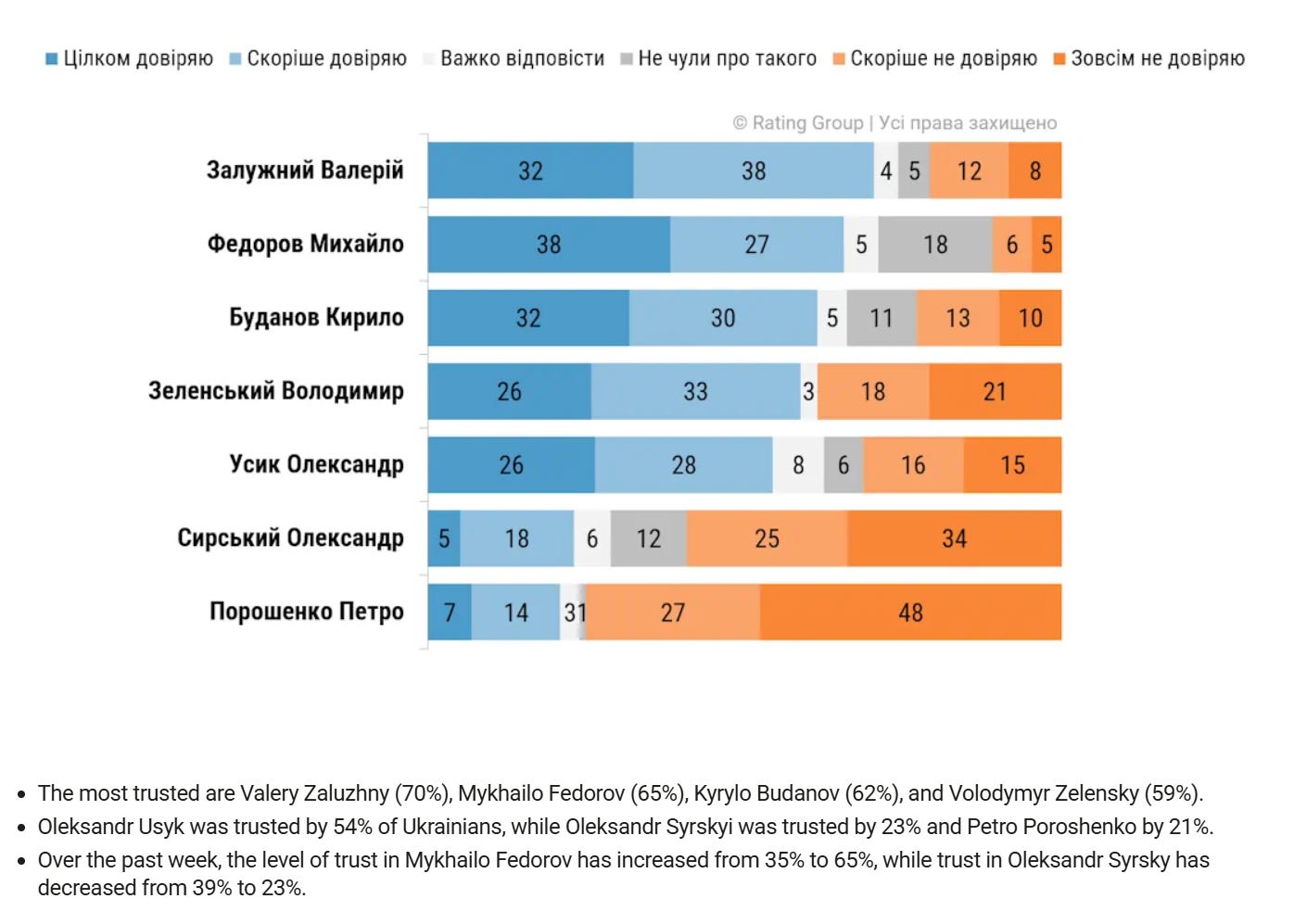
More directly political as a consideration, Fedorov came in third (just behind Zaluzhny) as voters preferred first choice if there were a presidential vote. That would mean he would be a very strong candidate to get into a run off with Zelensky, were he to run. Here were the headline figures on that part of the poll.
The top three in terms of electoral support are Volodymyr Zelensky (22.3%), Valery Zaluzhny (14.9%), and Mykhailo Fedorov (13.4%).
This is followed by Kyrylo Budanov (7.2%), Oleksandr Usyk (5.9%), Petro Poroshenko (4.6%), Ihor Terekhov (4.3%), Dmytro Razumkov (3.7%) and Andriy Biletsky (2.3%).
Btw, it is also worth noting that removing Syrskyi was very popular with 55% of the respondents approving the choice and only 15% opposing the move.
What does this mean? Well, it does seem that Zelensky is going to try and ride out the change for now. This is no knock on Khmara, but if this is how we end up, the worst week for Ukraine has not transformed into the best. We must still wait and see.
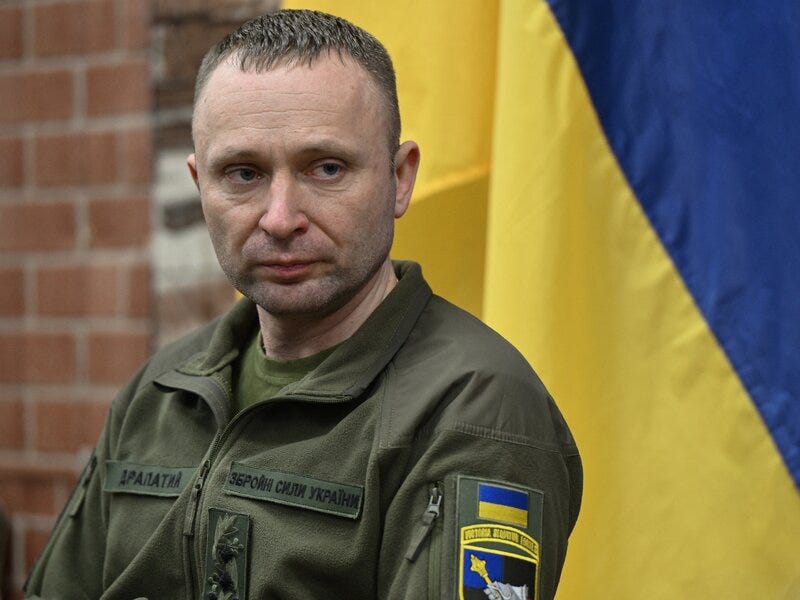
Major General Mykhailo Drapatyi
In Fedorov’s press conference, it is worth noting that he spoke about Drapatyi as a comrade in arms against Syrskyi. He was one of the few people given an actual name-check, and it was personal and showed that he believed Drapatyi, like himself, had been punished for being too independent.
Well done. Now off to the sidelines. Drapatyi — a third reprimand, goodbye. Forgive me, Drapatyi; I suspect you will receive a fourth reprimand after this.
And then, a few days later, Drapatyi was in and Syrskyi was out. This move, btw, was as mentioned above, greeted by universal acclaim by the Ukrainians to whom I speak. I have heard no criticism at all and lots of praise. Old friend and trusted adviser Mykola Bielieskov reached out immediately and wrote “Best choice of Zelensky”. When I asked Mykola if I could quote him explicitly on this, he agreed.
Drapatyi is one of those figures who was well-known in Ukraine but hardly known outside of it. And he is also rare in that he is universally respected and admired from practically all parts of society. He is a career soldier who has experienced the fighting since the Russians first invaded Ukraine in 2014. That year, when pro-Russian separatists tried to take control of Mariupol, it was reporedly Drapatyi who commanded the BMP who broke through the Russian barricades—and we have a video of that.
Though he has been around for the whole war, Drapatyi is still relatively young. He is only 43 (born in November 1982), making him 17 years younger than Syrskyi and leaving him with no Soviet military experience. That matters in Ukraine, where there is always a generational divide to consider.
Note: You can see the toll the war has had on him. He looks an old 43 years.
Here are a few other points about his career.
Graduated from the Kharkiv Tank Troops Institute; commissioned as a lieutenant in 2004, serving with the 72nd Separate Mechanised Brigade at Bila Tserkva.
Made his name in 2014 at Mariupol, leading an armoured push through a Russian barricade to relieve surrounded Ukrainian police, and later extracting an encircled force through Russian-held territory (see above).
Became Ukraine’s youngest commander of the Ground Forces in 2024. Resigned in 2025 after a Russian strike on an army training centre killed recruits — “an army in which no one is held accountable is dying from within” — which cemented his reputation with the rank and file.
Most recently commanded the Joint Forces, covering the Kharkiv-area front.
Associated with reform of recruitment and training, delegating initiative to front-line commanders, and the “Drone Line” project: a 10–15 km drone kill zone behind the line of contact.
The decision to resign and take responsibility for the 2025 strike which killed soldiers under his command is a sign of the kind of officer he is reported to be. He cares about his soldiers, accepts responsibility for his actions, and tries to act with the highest integrity. He reinforced that reputation after his appointment, when only releasing a very short statement in which he said he would offer “no loud promises”.
He has generally avoided the spotlight before. One of the very few interviews he ever gave previously, in 2023, revealed him to be pretty hard-core. He said that Russia as an imperial “nation” had no right to exist (which is different than saying that Russians had no right to exist—which is how his words have been twisted). The whole quote was:
"At the beginning, to be honest, there may have been some fear because everything was so uncertain... But in the end, we've seen the result. You can't even call them a neighbour. This is a nation, along with its leadership, that has no right to exist. Nothing civilized has changed there over millennia, neither in their mentality nor in their imperial ambitions."
Here is a story with that interview, all dubbed into English. It is worth watching if you have the time.
It is obviously early days and much needs to be done—but it is heartening to see the reception to his selection. The Ukrainian army needs a leader who will continue to head down the road of professionalization, fair treatment and no favoritism, and the integration of new technologies. In all these areas, he is at least poised to be a success.
Wildberries And Azov
People have asked about these two campaigns, so I thought I would give a quick update here at the end.
This week the Ukrainian long-range attacks on Russian Wildberries warehouses and infrastructure (think a Russian version of Amazon) very much continued apace. Indeed, since the campaign started on July 18, and it definitely is a campaign at this point, there have been up to 10 different strikes reported. These are, as far as I can tell (most from this Meduza report):
18 July — Elektrostal (Moscow Oblast) and Kotovsk (Tambov Oblast), two in one night. The Elektrostal fire burned for four days. Kotovsk partially resumed operations within two days.
20 July — Koledino (Moscow Oblast). Reportedly the warehouse kept working.
22 July — Krasnodar and Nevinnomyssk (Stavropol Krai). Neither had resumed as of the 24th.
23 July — Voronezh. Reportedly lighter damage.
24 July — Shushary (St Petersburg), Novosaratovka (Leningrad Oblast), and Simferopol (occupied Crimea). Both Petersburg-area sites caught fire; no detail on the Crimean sorting centre.
25 July — a warehouse in the Urals, per the Moscow Times; NPR’s Moscow correspondent called that overnight strike the tenth of the week.
This campaign causes some mixed emotions in me. If it distracts from the oil campaign, that is definitely not what I would say is an efficient use of Ukrainian resources. It seems that there have been only 5 strikes on refineries since the Wildberries campaign started. With oil prices back on the rise, I personally believe that efforts against the refineries remain top priority.
As for the benefits of the Wildberries campaign—I can see the argument that they will possess dual use components (though what percentage of their possessions are dual use is unknown and I would imagine small). I also understand the idea that it will disperse Russian air defense. So it can have some strategic advantages.
However, my guess is that this is really aimed at Putin’s political standing. It’s a way of undermining the basic “deal” of his regime with the Russian people—I will provide you goodies if you give me power. That bargain looks dicey if all your goodies are blowing up.
Such campaigns often do not work as expected, so this might be hopeful. Certainly, if it means that striking these warehouses distracts from the campaign against refineries, I find that an odd choice. However, it could be that the Ukrainians believe that Putin’s political standing is in trouble and this is a way to seriously undermine it.
The Ukrainian campaign in the Sea of Azov remains ongoing, though reliable data is scarce due to limited shipping reports. This last week the Ukrainians claimed to have continued to damage shipping at a very high clip. Most of the information comes from Robert Brovdi, the experienced Ukrainian UAV commander who is overseeing the campaign. On July 20-21, for instance, he claimed that the Ukrainians hit another 13 Russian ships. Here was how the Kyiv Independent story on the claims started.
Ukrainian drone strikes have hit another 13 Russian shadow fleet vessels in the Azov Sea and the Black Sea over the last two days, Commander of Ukraine’s Unmanned Systems Forces Robert Brovdi, known as “Madyar,” said on July 22.
The vessels struck on July 21-22 included 10 dry cargo ships, two tugboats, and a tanker, according to Brovdi. The Kyiv Independent couldn’t independently verify the Ukrainian claim.
“(Russia’s) shadow fleet vessels were warned by fire over a 48-hour period on July 21–22 that it was inadvisable to navigate the waters of the Azov and Black Seas in the interests of the aggressor country,” Brovdi said in his Telegram post.
The most important reality that I can find is that the Russians, who suspended official shipping on around July 10, have not formally changed that status, and the Russians are encouraging people to find other means of shipping grain, such as by rail.
So the campaign is ongoing and so far the Russians have yet to find an effective counter. Of course this is a campaign that will take time. It’s directed at cutting off Crimea and stopping Russian grain shipments (depriving Russia of money). Those seem to be happening, but their impact will take time.
Have a good rest of the weekend everyone!
Thank you for this insightful post. It exemplifies why you are my go-to for perspective on this war not to mention Trump‘s.
To this American supporter, you confirm what I’ve read elsewhere about Drapatyi, which is heartening. It is also heartening that Zelenskyy listened to his constituency, the Ukrainian people. I don’t think the man who defiantly said, “I need ammunition, not a ride”, and has demonstrated deft leadership in his relations with the EU not to mention the US, needs to worry about “saving face” were he to reverse himself and reappoint Federov as Minister of Defense. I would like to believe he shares with George Washington the perspective of himself in relation to the good and future of his country. God bless. Slava Ukraini!
Many thanks for this informative update as always.
We hear a lot about the Unmanned Systems Force and its commander Robert Brovdi. Do we know if he reports officially to the Armed Forces Commander or the Minister of Defence or to the President himself ? Is the change in the military leadership and the provisional change in the Ministry of Defence likely to have any effect on his operations ?
On another point, the Wildberries strikes might also in part be a reaction to the frequent Russian attacks on Ukrposhta warehouses. Ukraine does not have its equivalent of Wildberries but goods ordered by Ukrainians from on-line retailers transit through Ukrposhta.
And although we have heard a lot about attacks on Russian ships in the Sea of Azov, do we have any reliable information about Russian attacks on Ukrainian grain exporting ports like Odesa and Chornomorsk ? Are they likely to seriously damage Ukrainian export prospects? It is reported for instance that Maersk has already stopped its ships calling at Ukrainian Black Sea ports, citing security concerns.