Weekend Update #165: Why the Pantomime?
The Anchorage "Framework"; Storm/Shadow Scalps show the importance of Taurus/Tomahawks

Hi All,
Well, President Zelensky is on his way to Florida right now to meet with President Trump. Quite why they are meeting is a fascinating subject for discussion. The US is simultaneously running a two-track diplomacy. There are talks with the Russians, primarily Kirill Dmitriev, which are friendly and show common understandings. This was very much on display this week as well. Then there are talks with the Ukrainians, during which the US seems to be acting like an agent of Russia, trying to find out what they can get the Ukrainians to agree to on Putin’s behalf. Much of this might go back to the greatly misunderstood, or underestimated, Anchorage summit in August.
Another story this week involves the ranged war. The Ukrainians attacked Russian refineries. The latter was done with UK/French systems, which was revealing.
Finally, I wanted to extend a word of thanks and gratitude to the readers of this substack. This week saw the substack climb above 100,000 subscribers. It is a figure that is hard to grasp, but shows at least that some people gain something from these writings (and recordings).

I will continue to do my best to live up to the enormous trust you have placed in me. Thank you.
Why The Pantomime?
President Zelensky will meet with President Trump in a few hours. It was another hastily scheduled meeting between the two and has ostensibly been called to see if Ukraine can fully agree a new “peace” plan to present to Putin for the Russian dictator’s approval. We know a little of where the plan is, or at least what the Ukrainians want us to think what the plan says, because its 20 points were outlined to the press by the Zelensky government.
Of course, this Ukrainian version is probably not a reflection of where the Trump administration and Putin are. The US government has not acknowledged these points, and it is clear that the US has a completely separate dialogue going with the Russians. In fact, in a Politico story, Trump was asked about the status of the 20-point plan and the US president turned the tables on the Ukrainians. Trump said that he had not given approval to any new plan, and that Zelensky will have to wait and see what he does.
“He doesn’t have anything until I approve it,” Trump said. “So we’ll see what he’s got.”
In other words, Trump as always is trying to put Zelensky in his place. This is typical about how the Trump administration deals with Ukraine. Earlier in the week, US negotiator/bag man Steve Witkoff met with the Ukrainian negotiatior and former Defense Minister Rusten Umerov, and afterwards it was stated that there was no breakthrough in the talks. The US likes to string Ukraine along with hopeful noises but little of substance.
So there has been one dialogue going in between the Ukrainians and the Americans. At the same time there has been a very friendly dialogue between the Americans and Russians. Just over a week ago, Witkoff, Jared Kushner and Kremlin negotiator Kirill Dmitriev also met in Florida.
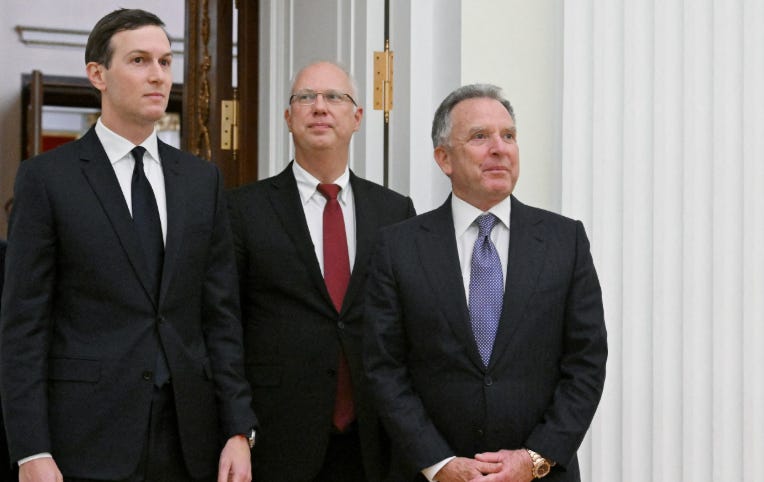
After the Florida meeting, Witkoff was very positive about the Russians, using language that must have been so pleasing to the Kremlin that one wonders if Dmitriev dictated it.
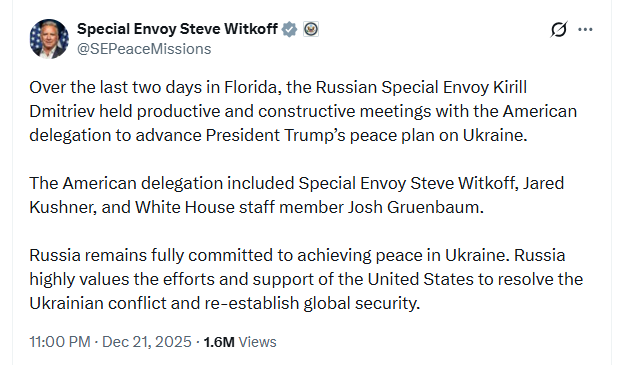
It is reassuring to know that Russia is fully committed to peace.
Moreover, it is revealing to see Witkoff refer to Russia’s invasion of Ukraine as the “Ukrainian conflict”. It seems Russia bears no responsibility for this war. There are certainly elements of pantomime in all this, particularly with US contacts with the Ukrainians. We have seen a form of this kind of “negotiation” for months. The US talks with Ukraine, blusters here and there, and then turns to Putin for his opinion and the Russian dictator says “no”.
Once Putin rejects any deal, Trump either blames the Ukrainians for being unreasonable or at at best “both sides” for their instransigence. And, voila, Russia gets a few more months to prosecute the war and commit its war crimes without any interference from the USA.
Something similar might very well be in the works. It was revealing that the Russian Deputy Foreign Minister, Sergei Ryabkov, pointed out that the 20-point plan the Ukrainians released was fundamentally different from what the Russians have been working on for weeks with the Trump administration.
"We know that this plan – if it can be called a plan at all – radically differs from the 27 points which we have been working on with the American side over the past few weeks, starting in early December”
So the Russians certainly believe that they are on the same page with the Trump administration.
So what might be going on here? The Americans who always like to pretend that Trump will support Ukraine, are discussing the 20-point plan as a sign that Trump is moving closer to Kyiv (even though Trump has said he has agreed to nothing similar).
So what could happen. In the dreams of the Pro-MAGA/Ukraine group, I imagine Trump and Zelensky will agree a common framework, and present it to Moscow. Putin will then object/reject and Trump will be freed to finally help Ukraine.
Best of luck with that.
What is more than likely is one of two options. First, Zelensky is pressured to make more concessions to return to something like the 28 point deal (which remains the position of the USG by the way). Second, Putin is presented with a new plan, turns it down or counters with the 28-point plan and, voila once again, the Russians get more time to batter Ukrainian cities over the harsh winter.
This is what I mean by “pantomime”. What we have more than likely seen over the last eleven months is play-acting designed to string Ukraine and European states along; to give them hope that Trump might break with Putin, but in actuality to give Russia more time to fight the war as it wants. It explains all the fake sanctions, public deceptions etc.
The US does the minimum to give Ukraine help, actually supports Russia materially in different ways, and waits/hopes for the war to swing Russia’s way.
Will it be different today? We will see.
The Anchorage “Framework”
Russian Deputy Foreign Minister Ryabkov also stated something else very interesting when he rejected the 20-point plan. He said that the new plan cannot be accepted by Russia because it differs greatly from the Anchorage “framework” which Trump and Putin already have in place. Framework in dipomatic speak is not a throw away word—it implies tangible areas of agreement.
“But the political will to remain within the framework set in Anchorage is not just fundamental for us; it is imperative. We cannot go beyond these limits; otherwise, it will not just be an unstable agreement – there will simply be no agreement at all”
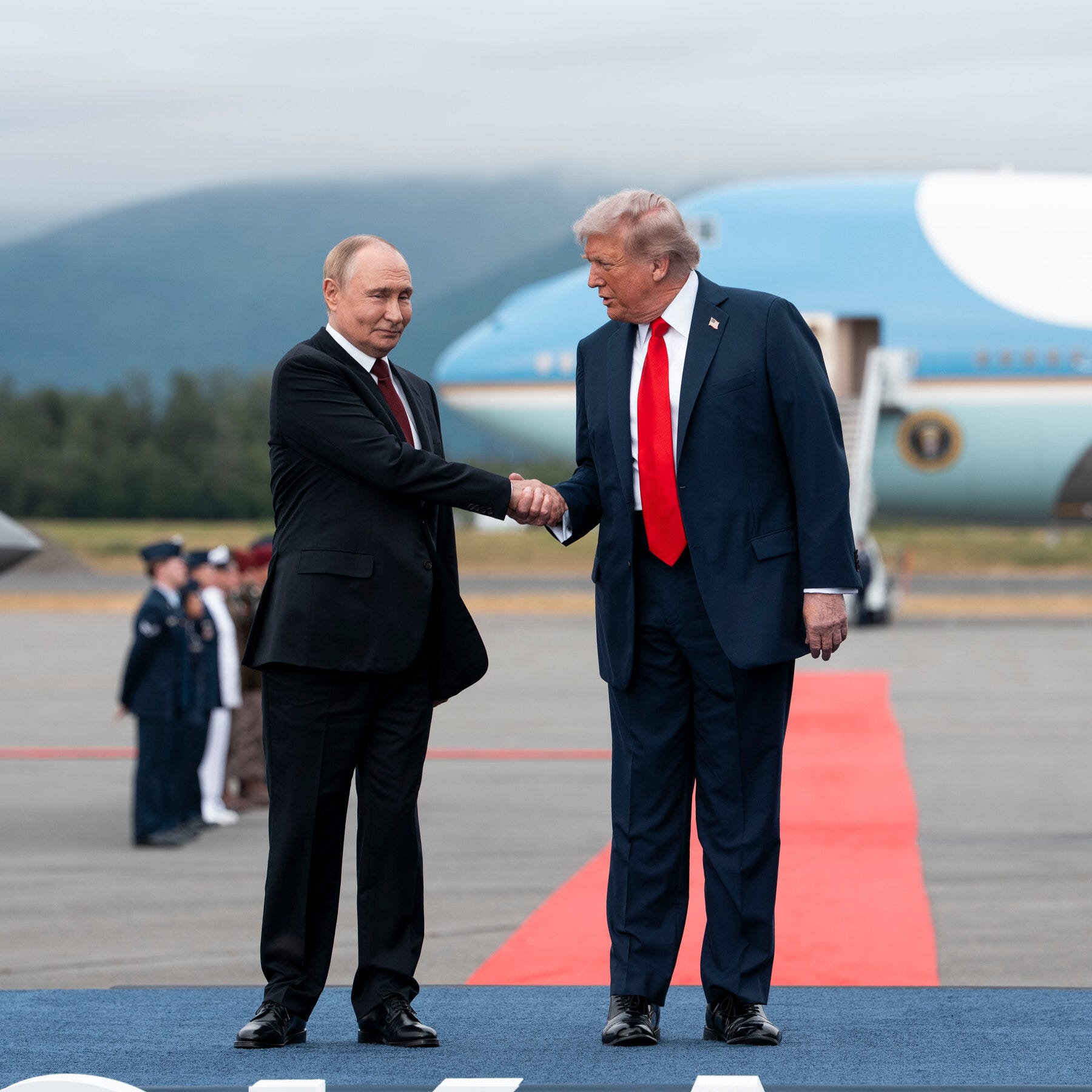
Ryabkov is not alone in speaking like this. Kremlin spokesman Dmitry Peskov, in discussing the US-Russian position this week also spoke as if a framework had been agreed at Anchorage. In his case, he spoke about the “spirit” of Anchorage.
To see just how central the Anchorage meeting now is to the Russian narrative, the Russian Foreign Ministry, in its summary of developments in 2025, gave it pride of place in discussing dealings with the Trump administration and certainly stated that an outline of a deal had been reached there. The word they use is “understandings”, which is also a meaningful one in diplomatic-speak.
After the new US administration came to the White House in January, political dialogue with Washington at the top levels was restored. During the Russia-US summit in Anchorage on August 15, understandings were reached that could form the basis for resolving the Ukraine conflict by addressing its underlying causes, including military threats to Russia created by NATO expansion and policies undermining the rights of the Russian and Russian-speaking populations.
The Russians are certainly not afraid now to publicly and regularly state that at Anchorage, Trump agreed with their vision of the war and accepted some of their fundamental negotiating positions. Indeed, their view is that the US and Russia have a tangible series of agreements in this area.
This position is fascinating, because there was a rush of hopelessly naive commentary after Anchorage that the Trump-Summit was some kind of failure; that the US and Russia had agreed on nothing. Actually, as I tried to say at the time, Anchorage was more than likely very important, if one bothered to look closely. Trump and Putin had actually aligned on some key points.
Here was the weekend update right after the Anchorage summit.
In the piece I mentioned that indeed Trump and Putin did seem to reach concrete understandings in Anchorage, particularly about the Donbas going to Russia and the fact that Russia had been incentivized by Trump at Anchorage to continue the war.
Here was what I said about the Donbas.
What has come out of Anchorage is that the US government believes that the key step in any peace deal is to force Ukraine to give up territory to Putin while getting practically nothing in return. Its probably the most important development from Anchorage, that the US is now seemingly committed to making Ukraine hand over at least the Donbas (if not more).
And here about Russia being protected to continue the war.
In other words—he (Trump) is going to keep doing what he is doing by trying to limit the Ukrainian war effort and provide cover for Putin. The war is going to go on for now, because Putin is being incentivized by the USA to do so.
Another sign that Anchorage saw some important understandings between the US and Russia was that a few weeks later, Trump pulled off one of the most effective moments of his con on Europe/Ukraine when he started saying Russia is weak and threatened the Russians with the mostly non-existent oil sanctions.
Where are those secondary sanctions btw? Can anyone find them for me? They were promised on November 21 and that is much more than two weeks ago….
And of course what was really happening in this period is that the US was agreeing the 28 point plan with Putin.
So Anchorage was no nothingburger, far from it. It looks like a very important moment in the US government joining the Russian government in an “understanding”. We can only hope the “spirit” of Anchorage does not result in one of the greatest moments of shame in US foreign policy history.
Storm/Shadow Scalps show the importance of Taurus/Tomahawks
A short section on why western cruise missiles remain very important for Ukraine, and why the US and Germany have both weakened Ukraine by not providing such systems to the Ukrainians. While the Russians have continued their terror campaign on Ukrainian cities, launching two large attacks on Kyiv this week, the Ukrainians have continued their campaign against legitimate military-industrial targets.
Three days ago, the Ukrainian general staff announced an attack on the large Novoshakhtinsk oil refinery in Russia's Rostov Oblast. Interestingly, they specified that in this case the attack was at least partly made by the British/French Storm Shadow/Scalp Cruise missile.

Normally we have to assume that when such systems are used, the Ukrainians consider it a very high value target and one that they believe that their own systems would struggle to damage in needed ways. This attack, for instance, was a repeat attack on the same facility, and there seems to have been a large number of systems involved as up to ten major explosions were recorded.
The issue with the Storm Shadows is that Ukraine only has a small number of them, and they are actually less effective than US or German equivalents. The Taurus, for instance, has better range and punch than the Storm Shadows, which is why it is the preferred missile in Europe these days. Likewise, the US-made Tomahawk missile has much greater range than the Storm Shadows.
And the US and Germany are both increasing production of newer cruise missiles, which would allow them to part with these older systems. Still, they are not being sent. The US is more on Russia’s side these days, so was just bluffing about Tomahawks earlier. However the Germans seem, even more than the British and French, to understand the real peril Europe is in. It is worth noting, then that they have an ability to help Ukraine in a way that no other power does (other than the USA).
Ukraine has shown what it can do with inferior systems. What they could do with better ones would be notable. I am not holding out hope that this will happen. However, it is worth pointing out.
Have a good rest of the weekend everyone and Merry Christmas a few days late!
Was there a real understanding in Anchorage, or is there a lot of bluffing by Russia? I can easily imagine that Trump was bored by Putin's history lecture, did not quite understand Putin's proposals (apparently Witkoff has misunderstood them earlier and then misinformed Trump) and just gave something less than a real commitment. But then once the Russians started acting like there was some sort of an agreement, Trump did not want to contradict them and tried to go along without fully embracing what they are saying. Sure, in Trump's case malice should always be suspected in his actions. But incompetence should not be forgotten either, and this situation may be a combined result of both.
The most surprising thing about Trump’s active support for Russia is how the hawks in the Republican Party let him get away with it. Trumps dominance of the party is clear but even so, this level of fealty on issues of national security is unheard of surely? Given that Reps have managed to place limits on US troop draw downs in Europe for example, is there some hope here? I’d be interested in your take on the US politics of this unfolding disaster Phillips.