The Great Debate Is Between The Wrong Choices
This Is The Debate We Should Be Having

Hello All,
Ok, final announcement on the changes coming in for the Substack. I still have not had a satisfactory answer to the question of what happens to people who are on free trials before July 1 (tomorrow) but whose trials end after that date. The background to this is explained here for those who do not know it. As I cannot say for sure if they will get the old price grandfathered in or whether they will get the new one, what I will do is move the increase date to the morning of July 9 (as soon as I get out of bed). That means that anyone who signs up for a free trial by the end of July 1 should be covered by the old price regardless. I am sorry for the confusion on this. I had not considered this as an issue when announcing the change. However this is it. July 9 it is and no more changes.
I hope never to discuss this again!
The Great Debate Is Between The Wrong Choices
Sometimes debates rumble on not because of their strong intellectual merits, but because of history, bureaucratic inertia, or simply innate conservatism (not an atypical phenomenon in militaries it must be said). One of my favorite historical examples of such a debate was the obstinate refusal of some officers in both US and British cavalry units, in the interwar period, to give up their horses in combat roles. They came up with a host of what seemed to be semi-plausible arguments to justify their emotional and bureaucratic preferences.
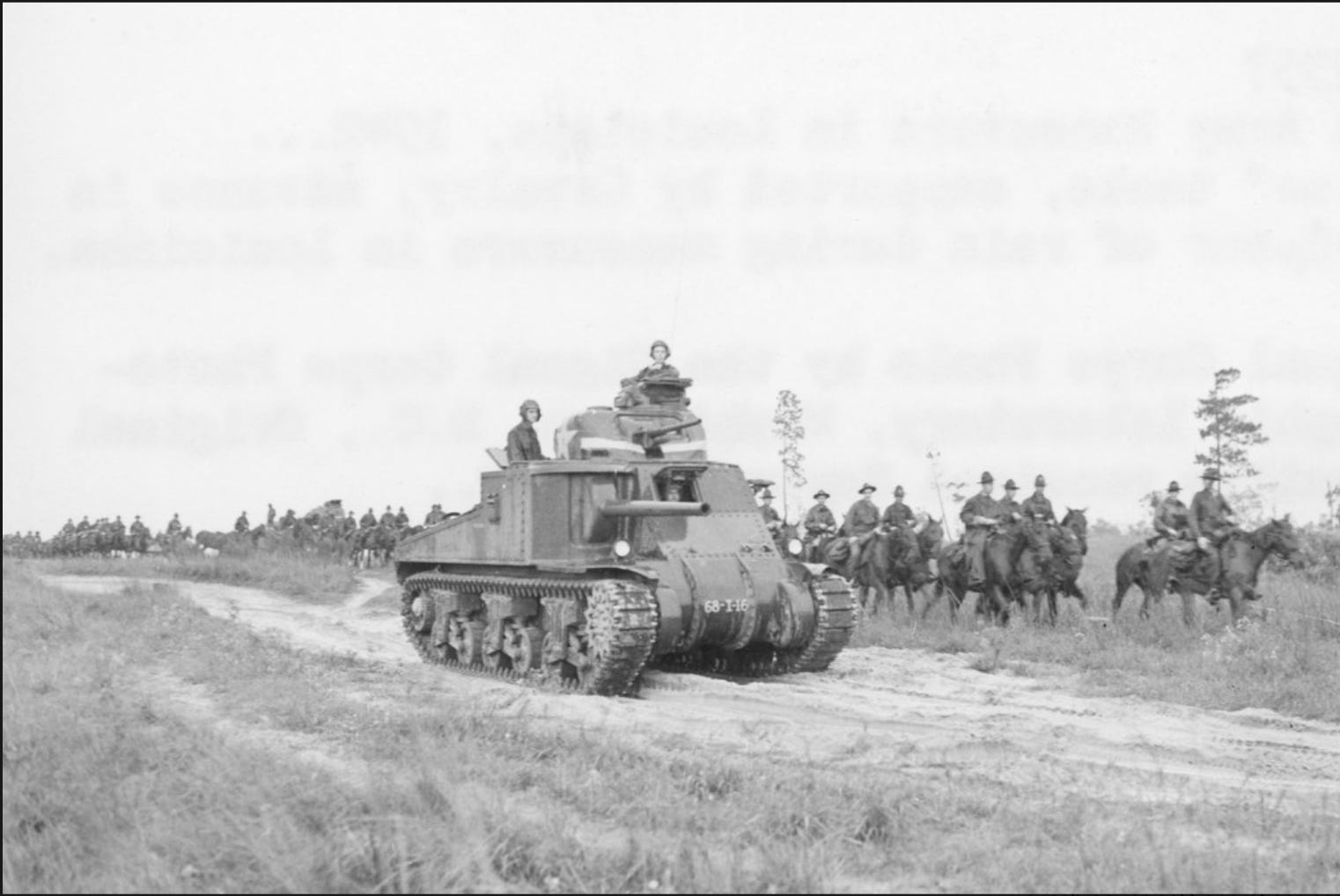
Some claimed that vehicles would never be able to handle all the different terrains that horses could master, and therefore it was imperative to keep the man in the saddle. Other arguments were that vehicle technology still had a long way to go to mature, and in the meantime, it would be a shame to give up on horses who were tried and true. One of the favorite arguments of the horse backers was to claim that these new-fangled mechanized technologies were simply not mature enough yet and in the meantime it was important to prevent some “sheep-like rush to mechanization.”
These arguments effectively delayed the transition of some cavalry units to mechanized status for decades—until after World War II started in some cases.
And then, lo and behold, the horse appeared in combat next to the tank and the whole debate was revealed as the farce that it was.
It is also worth noting that in the end it was the most obstinate defenders of the old order that lost out. Many of those fine cavalry officers who clung to their horses in the 1920s and 1930s ended up being useless at the start of the war and had to beg and borrow their way into mechanized units to see the action that they so desperately craved.
The current debate between whether the future (present actually) belongs to human controlled or remotely/artificially controlled combat vehicles on land, air and sea is much like the debate between cavalry and mechanization in the interwar period. It is ongoing, intense, and its result will make a big difference in the shape of future militaries for years if not decades.
But it is also partly ridiculous.
Now let me declare an interest. I have for many years, since before the Russian full-scale invasion of Ukraine, argued that large, expensive, manned weapons were on their way out. They seemed to me far too difficult to defend, actually limited in their capabilities, and wildly expensive. In other words, we were spending massive amounts of money to make systems less effective.
In the Spring of 2022, I imagined an impending future where smaller, cheaper defensive weapons would have the “computational performance” to push all these legacy systems towards obsolescence. Here was a quote from one piece which discussed this (I clearly did not anticipate at that point that everyone would soon opt to call these AI/Autonomous systems, but the point was the same).
Drones will be able to stay in the air for longer and avoid detection better, while increasing their lethality and improving their own computational performance. The ability of both to destroy heavy land vehicles while remaining unseen will improve. The massacre of Russian vehicles we have seen in Ukraine will become the norm, not the exception.
