
Hi All,
So, it turns out that D-Day was a really tough warning to Nazi Germany. “Watch out, Hitler!”, the US, UK and Canada were saying (remember—Canada was a close US ally), “We are really, really irritated with you and if you do not start behaving we are going to be super-duper mean to you—just not yet.”
An interesting reading of history, this.
Yet a new “D-Day” is precisely how the administration framed its sanctions announcement this week, presented by Secretary of the Treasury Scott Bessent. Of course a warning itself is too grand of a statement for what really happened. What the announcement revealed (and subsequent Chinese actions have confirmed) is that the USA is too weak now to actually pressure China. Indeed, Bessent admitted that actually bringing in these sanctions against major Chinese companies would be a catastrophe. As such, the announcement was a sign of how weak the USA has become.
Two more stories. There has been a fascinating, predictable and yet hollow attempt by Trump backers to call the war a victory, or impending victory—with not a single strategic achievement to its name. This was to be expected and, btw, will only grow with the elections approaching. Still, it is worth delving into it, to show just how deep the US defeat is. The best sign of a US victory that is actually being offered is that the situation in the Gulf might revert back to that of February 27, 2026. Nice.
The final section is about how the Pentagon is going backwards in its preparation for war. I fear this is going to be a regular part of these updates.
Sanctions Without China Are A Sign Of Defeat
On August 24, the United States, to great fanfare, announced Operation Economic Outcast. This was its much ballyhooed plan to crush the Iranian economy by sanctioning its key enablers. If you want, you can watch the whole press conference during which Secretary Bessent laid out the details of the operation.
The objective was very clear, as Bessent said at the start—to “sever” Iran’s economic connection with the outside world. This was one of his earliest comments.
Our objective is to sever every economic lifeline that sustains this tyrannical regime until Tehran stands alone.
Now if this could be done, it would indeed be economically devastating to Iran. The problem that the USA faces, however, is very simple. Iran’s biggest economic partner (by far) and the state which supplies it with the vast amount of its foreign capital, is the People’s Republic of China. In 2025, the last full year, the Chinese were responsible for purchasing more than 80% of the oil that Iran shipped.
During the war, Iran has continued to ship China significant amounts of oil. Here is a Guardian chart on the shipments that have gone on throughout the war until the end of July.
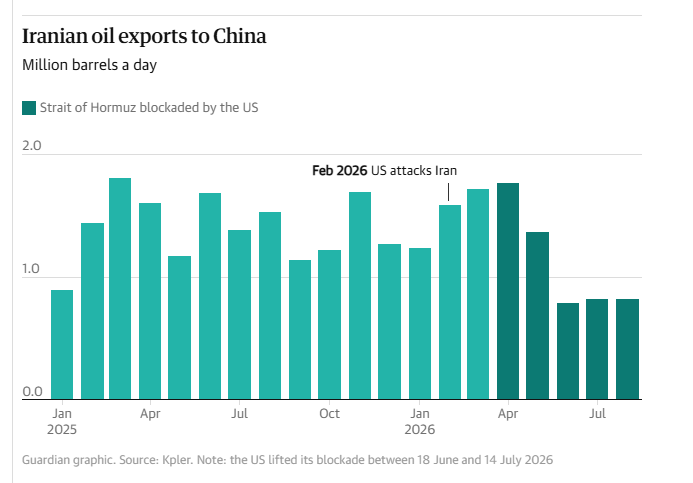
So actually from the start of the war, for three months, oil shipments between Iran and China were some of the highest on record (and remember prices also rose steeply, so that Iran was making record amounts). Since the US doubled down on the blockade in June, shipments have fallen. However, as oil is still 50% or more expensive that it was in 2025, Iranian income even now is running at a rate that is not too dissimilar from last year.
And the US is obviously too afraid to stop that traffic and offend China—which became more and more apparent as Bessent talked and was asked about the details of the sanctions. When it came to China, the Secretary of the Treasury tried to act tough, but had to admit that not a single significant sanction was being enacted now. Here was the first question and answer that he had about China from the member of the press. Note how Bessent is delaying all harsh action until the future.
Q. Hi, thanks, Secretary. Um, one of the most powerful tools you have at your disposal is the ability to impose secondary sanctions on on banks and financial institutions that facilitate transactions for Iran. Um, Chinese banks uh have often been talk talked about being targeted, but we don’t see any any of those institutions targeted here. Is that something that is coming in this campaign or is is the uh very delicate trade truce with China something that that could prohibit you from, you know, going that far and taking that very big step?
A. (Bessent speaking). Uh we want to make clear to here today that no one is above the reach of US sanctions that if they facilitate transactions and are part of the ecosystem that turns Iranian oil into money into repression they will be targeted. We find that the best way to engage with countries is through quiet diplomacy and we are level setting with every country to tell them our expectations. We know who they are. They know who they are. So when the hammer of US Treasury actions falls upon them, they will have no one to blame but themselves
Later a reporter asked about whether these were real sanctions or simply threats, and Bessent lost control of his response and basically admitted that they were pretty empty threats, because to follow through on them (and attack the Chinese) would “blow up the global financial system” (see bold).
Q. You described this as an economic D-Day, but D-Day wasn't a threat of an invasion and the US didn't give a timeline to Germany. So, why not impose the sanctions today?
A. (Bessent speaking). Well, we we are giving everyone the opportunity the to remedy bad behavior. Why would I want to blow up the global financial system?
By admitting that these sanctions, if enforced, would lead to a catastrophic situation, Bessent was admitting that they were almost certainly a bluff.
However, the Chinese government decided to put the US in its place immediately. Yesterday they rejected all US interference in their business with Iran. Chinese Foreign ministry spokesman Lin Jian said China was firmly opposed to what it called "illegal unilateral sanctions" and would take "all necessary measures" to safeguard its rights.
He then went on to tell the US to butt out.
"Cooperation between China and Iran has always been conducted within the framework of international law and should not be interfered with or disrupted."
Indeed, as this Japanese story intimated, the Chinese are delighted about the US being in a strategic box over Iran, and have no desire to help the USA out. Indeed, the Chinese interest is in stringing this out for the USA, as it is weakening America steadily.
It is noteworthy how the press in the Asia-Pacific is far more honest about what is happening here than the US press. There is an extraordinarily self-destructive voice in the US press, desperate to appeal to Trump, which regularly tries to put a very positive gloss on what is happening. As the next story will show, this reached a rather bizarre state in the last few days.
The reality is this. The USA cannot afford to antagonize China, as it is too weak militarily and too economically dependent on China. Moreover, Trump remains desperate to stay in President Xi’s good books. Remember, this is the man who Trump praised lavishly in June for being “very smart” of being of “great stature” and of being “a strong man”.
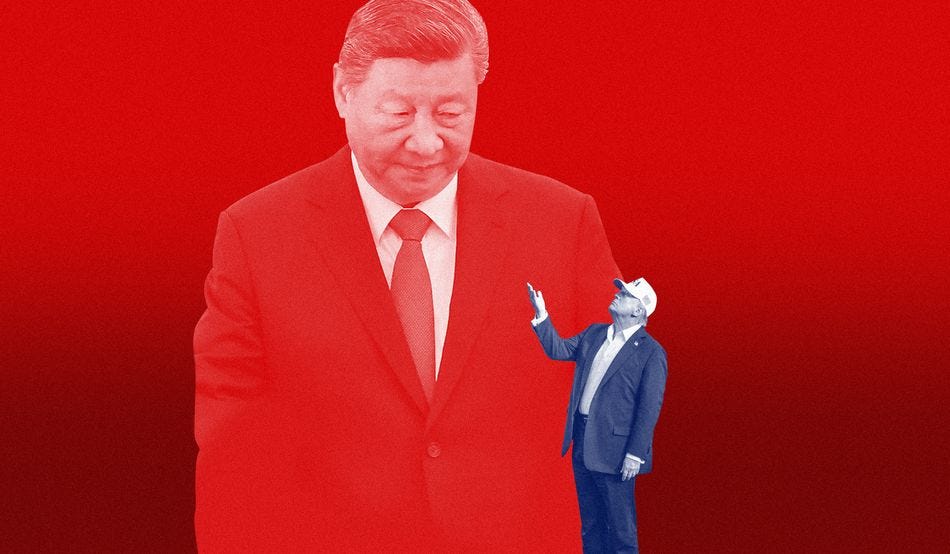
If the USA will not sanction China, and that looks extremely likely after this week, then it really cannot sanction Iran. This is what a weakened America looks like.
So, It Turns Out That The US Is Winning!
As I mentioned above, a section of the US press is so desperate to praise and pump up Donald Trump that they are now turning the Iran debacle into a great US victory.
