Midweek Update #2: The Two Wars
Also: What Might Be Happening In US and Iranian Strategic Thinking.

Hello All,
Well, regrettably in many ways, it looks like there will be some more of these midweek updates on the US/Israeli campaign against Iran. This one will focus on the two very different wars that are being fought, one by the US/Israel and the other by Iran. In many ways what we are seeing is a clash of diametrically opposite war capabilities and an inability of either side to do a great deal to stop the other from fighting in its preferred fashion. In that way, both could be said to be winning and both could be said to be losing.
Also this week, some analysis grounded in background discussions of what the Trump administration is weighing up in terms of action. This war, no matter what they say, has gone down a completely different road than they expected and the President in particular is now contemplating actions that were not in his mind just two weeks ago. The logic, for now, seems to point towards escalation unless Iran changes. Also a few words on possible Iranian strategic thinking, with an open admission that I am no expert.
The Two Wars
War is often seen as a process engaging two sides in one struggle over specific places or strategic objectives. Thus we can have two armies fighting over a town (say Pokrovsk or Stalingrad) or two navies fighting it out on the high seas (say Midway or the Black Sea). However in this case we seem to have two armed forces in some ways fighting two very different wars and both struggling to actually stop the other from fighting in their preferred manner. In that way both are winning and both are losing. The dilemma that both face is trying to stop their enemy from fighting their enemy’s preferred war while using the war they have chosen to extract the political concessions they both crave. In that way we are seeing two distinct wars developing, not one.
Here is how these wars might be understood and the problems facing each.
The US/Israeli War: US and Israeli forces in conventional terms have achieved something notable. Building on the destruction of Iranian air defenses last year, they now have the ability to attack from the air almost any target that they want using aircraft or missiles. In that sense they have air superiority if not at their finger tips, then at least on speed dial. The Iranian air force is non-existent, Iranian air defenses seem unable to stop US led attacks, and as such on a daily basis the US decision is not so much what can they attack but what do they want to attack. And they are doing these attacks at a very high rate.
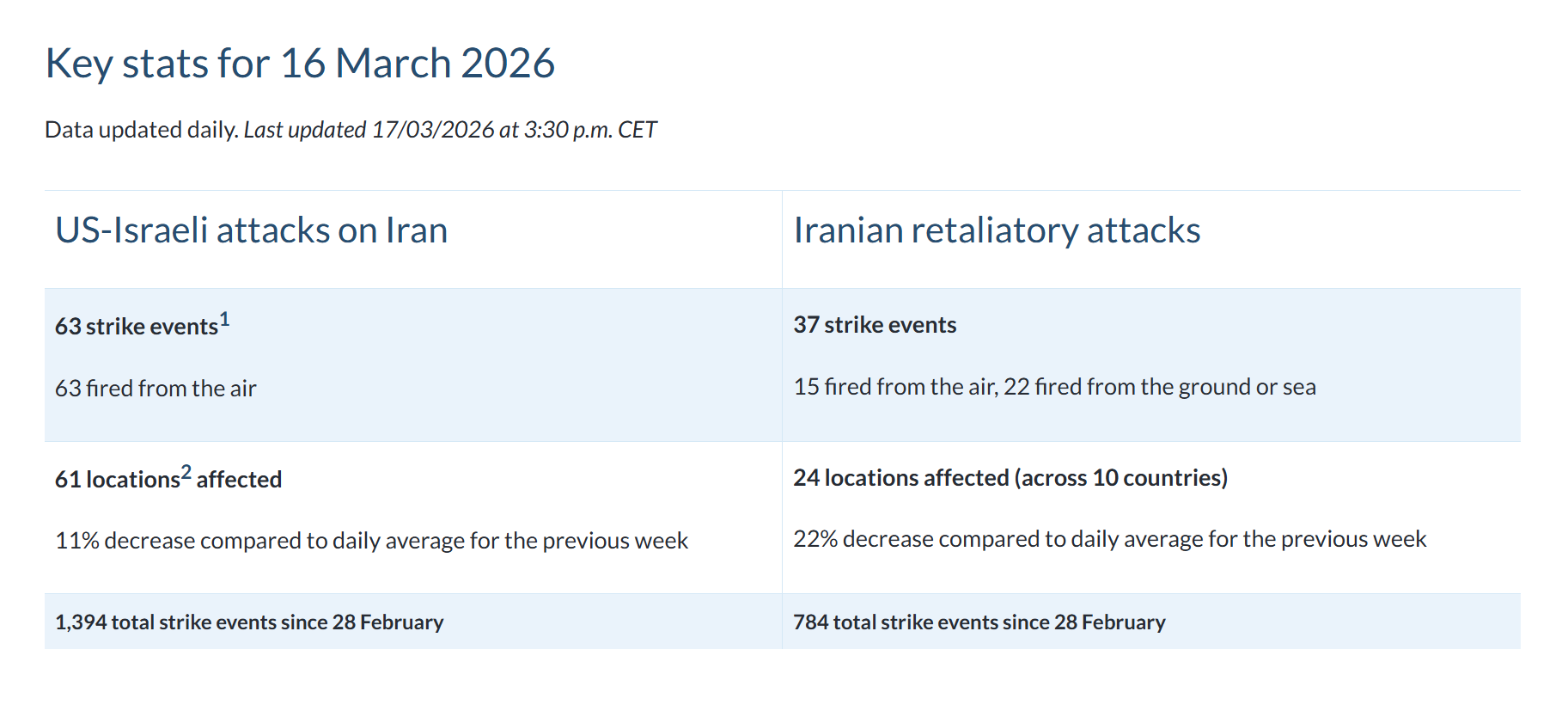
ACLED (Armed Conflict Location & Event Data Project), provides a daily data set on attacks and some helpful maps. They, for instance, had the US and Israel launch 63 strikes against 61 locations on 16 March, and in return Iran launched 37 strikes against 24 locations.
Here is their map of the conflict zone as well.
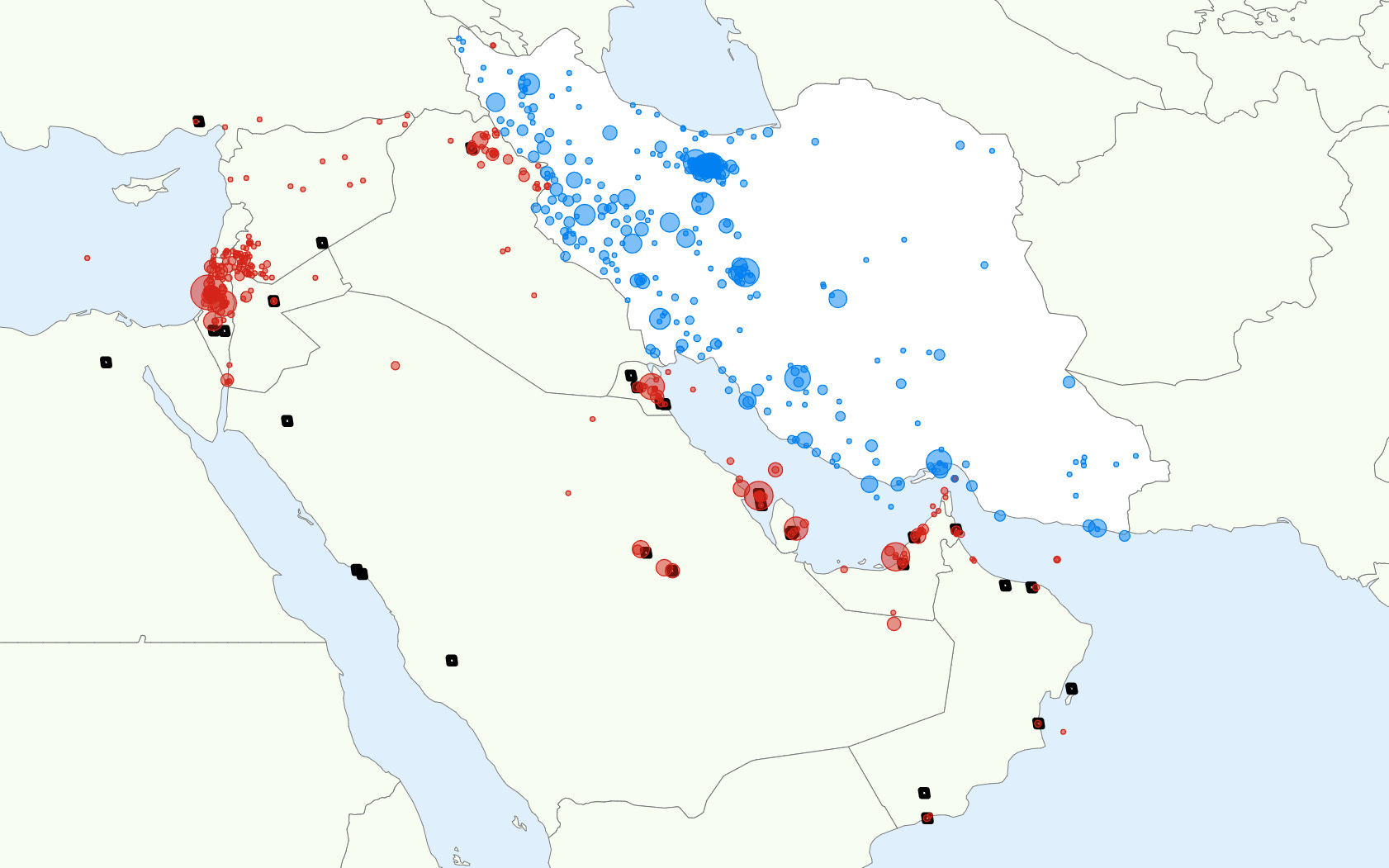
Now US/Israeli attacks are far more powerful and accurate than Iranian attacks—to say nothing of far more expensive. Their advanced, high-tech systems are much better than anything the Iranians can hope to field and can wreak great damage across Iran. The US and Israel also clearly have excellent intelligence in some regards. They seem to be able, for instance, to uncover the location of key Iranian leaders and have continued to assassinate them. This includes Iranian security chief Ali Larijani, who was killed in an air strike yesterday.
So the US and Israel can basically destroy almost anything that they can find. Why, then, are they not winning? Well they cannot find everything to begin with. The Iranian war against them is based increasingly on cheap, small systems that can be widely dispersed and quickly moved. While the US and Israel can degrade Iranian capacities, they are struggling to wipe them out. And that means (see below) that so far they have been unable to stop Iran from waging its very different war.
The other problem the US/Israel face is that they cannot achieve their political objectives by simply blowing things up. They need Iran to politically end the war, but that will require either a completely new Iranian regime or power to be seized by those in Iran who want to end the war. So far this part of the campaign has been a failure so far by the US and Israel. In my first piece right after the bombing started, I posed three questions to ask to see how the US/Israeli campaign was going. They were:
How do they intend to use airpower to overthrow a regime? I assume that political decapitation is part if not central to this goal. If so, one assumes that after the destruction of all Iranian anti-air forces (called SEAD, suppression of enemy air defense) the next goal will be to go after Iran’s political leadership. It will be a question of two things—do they know where these people are, and are they in places where they can be reached by airpower?
Have they identified and started collaborating with forces in Iran? Trump in his announcement called for Iranian forces to “lay down their weapons” but in exchange offered them “total immunity”. So clearly the administration is hoping that forces within Iran will go along with them. They were able to identify and work with forces in Venezuela when they went and seized Maduro, though this will be more challenging. Still, they should have had time to prepare something.
Will the Iranian people rise up? This is obviously something for which Trump is hoping. He even referred to this bombing campaign as the “last opportunity” that the Iranian people will have to get rid of their regime. However, things are complicated by the fact that on January 13 (almost seven weeks ago) he did the same thing and did not follow up. So the Iranian people have been badly burned by him, and we do not know what they are thinking.
The answers to questions two and three show the limitations of what the US and Israel are doing. So far they have not been able to work with forces within the regime to take power and end the fighting. Nor are there any signs that the Iranian people have been encouraged by the campaign and are rising up to seize power, no matter how many times Trump or Netanyahu say that they should. Indeed, if this story in the Washington Post is accurate, behind the scenes, US and Israeli sources understand that they have clearly not been able to create a political situation in Iran that would allow an uprising to succeed.
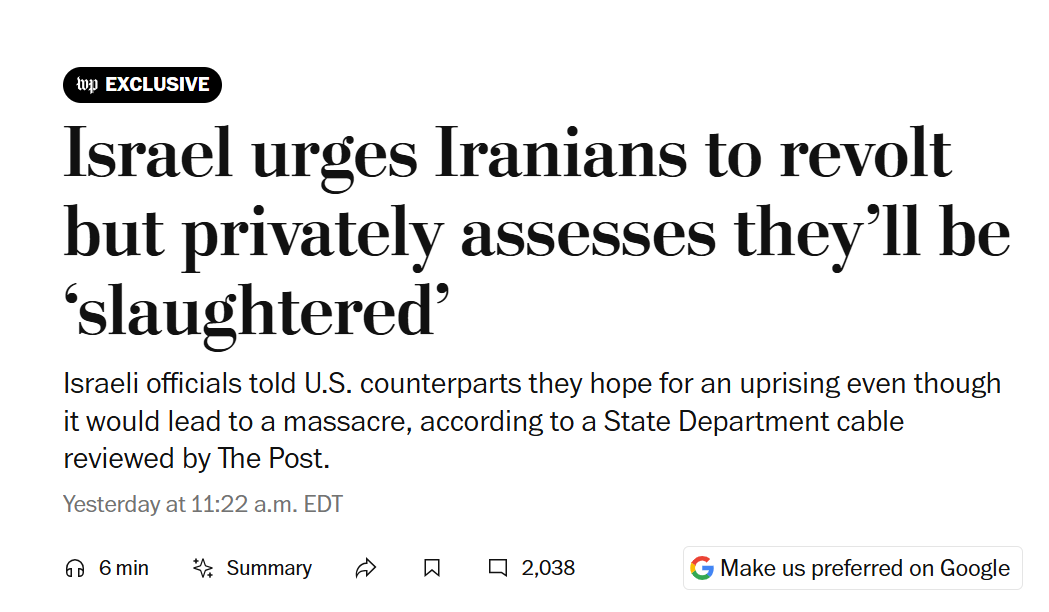
So the US and Israel have a great advantage in being able to attack what they want when they want, but they are struggling translating that advantage into political success. That could still change. They could kill so many Iranian leaders that eventually they get some who will give them a deal that they want, or they could cause such chaos on the ground that the Iranian people lose all reluctance and are willing to risk “slaughter”. If, however, the US and Israel cannot achieve such gains, this campaign will almost be seen as a failure.
The Iranian War
The Iranians seem to have no way to stop their enemies, and yet they are still in this war with some strategic advantages. How did this happen? Well that is because they have decided to fight a very different war against very different targets. The Iranians ability to hit US or Israeli military forces, as long as those forces are based at a distance, was small to begin with and is probably on a downwards trajectory.
However the Iranians have decided to attack the US and Israel not by attacking their forces, but by attacking the world economy, the protection of which has been a US priority for 80 years. The Iranian war is to take advantage of two things, geography and cheap attack systems, to threaten the world economy to such a degree that the US and Israel will be forced to give them a political deal that they want.
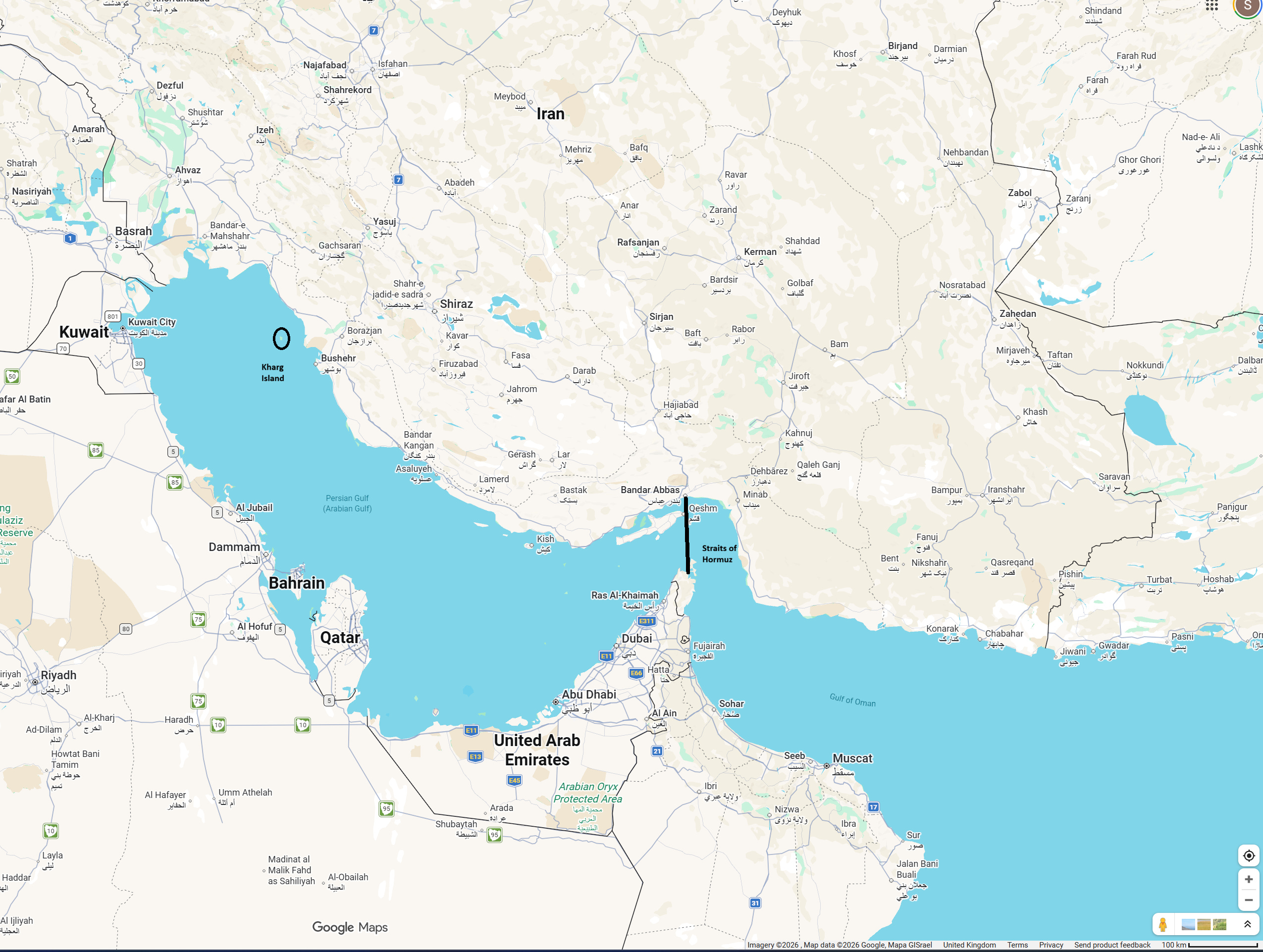
The geographic advantage is obvious. Iran sits along the entire north shore of the Persian Gulf and has a chokehold over shipping heading in and out of the Gulf at the Straits of Hormuz (but can actually attack shipping almost anywhere in the Gulf. Here is a map that I have just put together on the area with two notable markers. The black solid line is the Straits of Hormuz is Iran’s chokehold on shipping in and out of the Gulf (though they can attack almost anywhere) and the circle is around Kharg Island, which is Iran’s most important oil terminal.
So Iran has massive geographic advantages over the Persian Gulf and this is no ordinary body of water. The IEA summarized its pivotal nature for oil trade as follows:
The Strait of Hormuz, through which an average of 20 million barrels per day (mb/d) of crude oil and oil products were shipped in 2025, is one of the world's most critical oil transit chokepoints. With around 25% of the world’s seaborne oil trade transiting the Strait, and options to bypass it being limited, any disruption to flows through the Strait would have huge consequences for world oil markets.
And as it turns out, it is not just oil. A large percentage of the world’s nitrogen and helium trade passes through these waters, which compounds Iran’s strategic advantage. If trade is stopped for any significant period through the Gulf not only will oil prices rise, but food prices could go up, computer chip/semiconductor production (which relies on helium it turns out) would go down, even paracetamol supplies could run short.
In other words, this small body of water is one of the few absolutely vital logistic routes for the entire world.
And technological developments of the type we have seen in the Russo-Ukraine war have revealed that closing such a body of water if you have access to a shoreline such as Iran has become surprisingly and scarily cheap. Using inexpensive shahed type drones and small unmanned sea drones, Iran can now threaten shipping throughout the Gulf—and has. The BBC has this striking timelapse video of civilian shipping almost stopping completely in a few days at the start of the bombing. Here is a chart from another Substack that shows the decline more statistically.
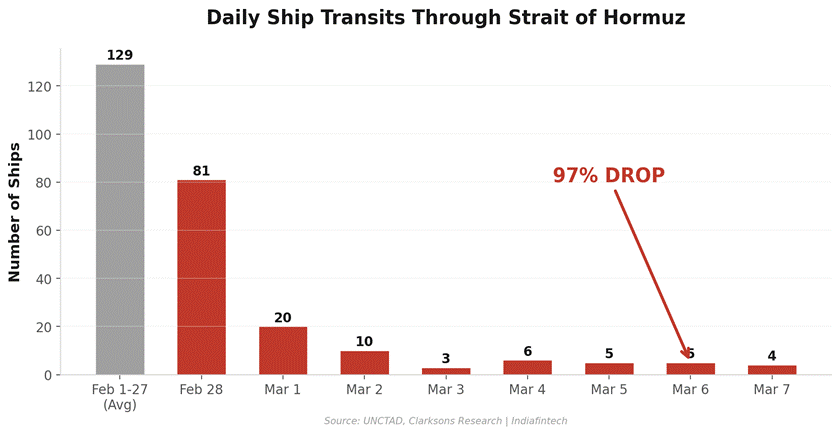
So Iran’s war is completely different from that of the US and Israel. It is to use cheap, easy to move, small systems to wage war on the world economy. They are not capable of stopping the US and Israel, they plan to use political/economic pressure to force the US and Israel to back off.
Conclusion
In some ways both wars are races against time. The US and Israel cannot bomb forever (the cost will become prohibitive, US aircraft carriers will need to leave, etc) and the US cannot tolerate the Straits of Hormuz being closed for months. That is a huge political threat to Donald Trump and one must always remember this war has been started by Trump for his own perceived advantage. So the US and Israel are under great pressure to reopen trade and crack the Iranian government sooner rather than later.
The Iranian regime is also under time pressure. It needs to survive—and the longer it can be targeted with impunity from the air, the more difficulty regime-survival will be. Thus we have two different wars with two very different objectives and even two very different military ways and means. The problem for the US, bluntly, is that it has probably the greatest time pressure, which will be discussed below.
What Is Happening In US and Iranian Strategic Thinking?
This is a highly speculative section, particularly on Iranian strategic thinking about which I am no expert and do not claim any specialized knowledge. When it comes to US strategic thinking I feel I am on safer ground and I have been talking to people in Washington who know what the administration is thinking far better than I and have helped me understand what is happening. So I feel pretty confident in what I am saying about Trump and the administration and admit the Iranian section is far less solid.
The State of US Strategic Thinking
The Trump administration is now fighting a war it did not plan for and for which it had no contingency plans. Much like Vladimir Putin, who expected Ukraine to collapse in a few days in February 2022, Donald Trump expected a quick and easy win over the Iranian regime.
There was a story in The Middle East Eye by a credible source that the US had told the Turkish government that this war would be over in four days.
“Turkey and some of its allies were told, through official channels, that this operation would take days and be completed in four days,” Aydintasbas, a fellow at the Brookings Institution, said in an interview with the Serbestiyet news site.”
While I have not heard the specific four day claim repeated by anyone in Washington, I have heard a few times that Trump really believed that this would be a form of Venezuela mark 2—relatively quick and easy.
Now Trump did not expect wholesale regime change and the liberation of the Iranian people, about whom he could care less. He really did expect that he would hit the existing Iranian leadership, remove/kill many of its senior members and devastate Iran across the country in a series of impressive air strikes. The result of this would be, in Trump’s mind, that a much more agreeable version of the present regime would take power and defer to him as their strategic big daddy. They would thus give him a deal on nuclear weapons and start the money taps flowing.
Unfortunately for him, it has been nothing of the sort, as he even admitted publicly just over a day ago.
"They weren't supposed to go after all these other countries in the Middle East. Those missiles were sent to go after them. They hit Qatar, Saudi Arabia, UAE, Bahrain, Kuwait," Trump told reporters. "Nobody expected that. We were shocked. You know, ...”
This strategic blunder has led to what can only be called a form of panic in the White House. To be honest, from what I am hearing, Trump would desperately like to wash his hands of the war. He would prefer to declare victory and go home. This is why he has been trying to bully/threaten other states to take responsibility for reopening the straits.
However, if no one else will take responsibility (which looks unlikely), then he understands he is in a real bind. He cannot simply walk away because Iran might keep up its war and still shut down trade in the Gulf even if the US leaves. This would make his war a catastrophic defeat for the USA, with terrible political ramifications for the Republicans and his own power in the 2026 elections.
Therefore, what is now a strong possibility is that, even though he would like to end this war, he will end up escalating it. He will do something to try and force the Iranians to open the straits and let the trade flow again. The question being faced is what kind of escalation might achieve this. One idea is that seizing Kharg Island (circled above) would force the Iranians to relent. That is a risk, however, Kharg Island is itself liable to attack from the Iranian mainland and there is no guarantee if the US take it that Iran will let traffic flow.
The other idea is to try and navally patrol the Gulf and possibly use ground troops on Iran’s south coast, to protect maritime traffic as it enters and leaves the Gulf. This, might be even a greater risk as it leaves very valuable targets constantly at risk and the Iranian coast line is so long that there is no guarantee that trade can be protected anyway.
In other words, Trump is starting to believe that he needs to ramp up the fighting, but he cannot guarantee that the escalation he chooses will actually achieve what he wants, and whatever he does runs great risks. You can see just how he is in a state of panic at his press conference yesterday with Irish Taoiseach, Micheál Martin. It is worth watching in depth to see someone who is flailing around.
So US strategy is heading towards escalation because Trump cannot admit defeat and cannot guarantee that Iran will let trade flow even if he does.
The State of Iranian Strategic Thinking
Again, this is a guess based on what we are seeing and what I am hearing from people in Washington. Be warned.
The Iranians seem willing to try and outlast the US on this one. They do not want some interim settlement that will allow Israel and the US to regroup and come back at them in a few months or a year. They seem to believe that their regime integrity is strong enough to withstand the air assaults and that they have enough weaponry to continue to threaten trade for a while.
As such, they believe that they can keep shutting down trade until they get their way and the US fully backs off.
This, if true, seems to me like a very ambitious set of strategic assumptions. They might be overestimating their regime strength, how they will react if their leaders continue to get killed, and whether Trump might escalate more than they expect.
In other words, add this all together and this war could get far worse before it gets better.
Yup. Trump's Special Military Operation.
In 1980-81 the Iranians held US hostages for 444 days, possibly the key in Jimmy Carter’s election defeat. I don’t have a reason to think they won’t be similarly patient in taking down Trump. After all, it will absolutely work if they just hang on for a few months. And as far as ‘negotiating’ with Iran — Trump and Netanyahu have gleefully murdered all the past and future negotiators, so good luck with that.