Midweek Update #16: Negotiating Without Leverage And With Lies
What We Are Seeing Is Astonishing For The USA

Hello All,
Well even though there is now a ceasefire (of sorts) between the USA and Iran, and oil is starting to flow and the price is declining, I will keep doing these midweek updates for a little longer for one main reason. That reason is that there is no actual peace deal at this time and the whole negotiating process could break down at any time. Now, I do not think there will be a total break down or if one occurs that it will not last for long, for the simple reason that the USA is now negotiating without much, if any, leverage. That really is extraordinary. The Trump administration has put itself in a position where it cannot go back to the use of military force, cannot put much if any real pressure on Iran, and therefore will have to concede most of the main points to the Iranians. And as the past week showed, the Iranians understand this.
Personally, I have never seen the US in such a position of weakness.
Because the US has no significant leverage over Iran, the Trump administration (as it has been for months, it needs to be said) will simply have to dissemble about non-existent Iranian concessions to try and make it seem that they have not been completely routed. And that is the second part of this update. The US government has reached the stage where the default assumption must be that it is lying when it comes to Iran making any concessions. For months the Administration has been claiming that Iran was agreeing to this concession or that concession—and none of these claims has been true. Now that the US has even less leverage, the lies will probably get larger.
We are witnessing the most extraordinary negotiating moment in the history of US foreign relations, and that alone makes it worthy of note.
Negotiating Without Leverage
Trump loves to publicly threaten to destroy/obliterate/wipe out the Iranians. He has been doing it for months and over the last week he did it a few times. First, during the G7 Meeting in France, trying to act all tough, Trump said if Iran did not negotiate the way he wanted, he was going to “go back to dropping bombs right smack in the middle of their head”.
Then on June 21, just as US-Iranian negotiations were starting in Switzerland, Trump stepped his threats up a level. First in an interview with a Fox News reporter, Trump went all medieval and said that that he personally told Iranian officials that if the Iranians continued to block the Strait of Hormuz, “they would not make it back to their f@cking country.” He followed this up just a little while later with another one of his tweet threats—this time saying if Iran did not keep Hezbollah in line, he would make them suffer.
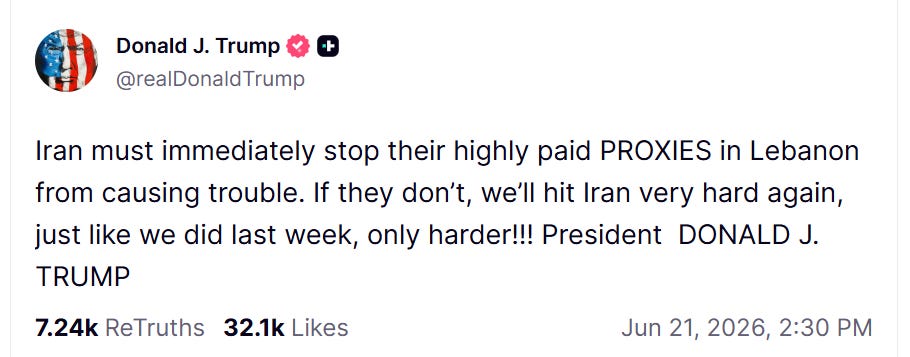
Note: Iran is not really keeping Hezbollah from causing trouble.
The Iranian reaction to Trump threats was to call his bluster. The Iranian team in Switzerland declared Trump's rhetoric to be an “unacceptable threat to their personal safety.” They formally walked out of face-to-face talks, met with Qatari mediators, and exited the main negotiating venue, sending the talks into a “difficult phase”.
After making their point that Trump’s threats were weak and counterproductive, the Iranians returned to the negotiations (they were going to get major concessions mind you). And guess what—Trump has shut up with the threats to return to bombing or wipe out Iran. Indeed, VP JD Vance, who was leading US negotiators in Switzerland, tried to make light of Trump’s threats to the Iranians in the first place—it was just a little friendly trash-talking. “What we told the Iranians yesterday is that when you guys engage in what us millennials might call 'trash talk,' you can't expect the president of the United States not to respond and not to correct the record.”
And then the negotiations went on and Iran, as always seemed to get most of what it wanted. Indeed, the concessions that Iran has received in the last few days is pretty remarkable. Here is a list of two of them:
Sanctions Waivers and Energy Concessions
On Monday, June 22, the U.S. Treasury Department issued a sweeping temporary suspension of core energy sanctions, representing the most substantial relaxation of U.S. economic restrictions on Tehran in decades.
The 60-Day Oil Waiver: The U.S. Treasury formally waived all existing sanctions blocking the production, delivery, and sale of crude oil, petroleum products, and petrochemical derivatives of Iranian origin. The waiver remains legally valid through August 21, 2026.
Transaction and Service Clearing: The waiver explicitly clears necessary secondary infrastructure to facilitate these sales, including global banking transactions, maritime insurance, and international shipping services.
U.S. Dollar Transactions: For the first time in decades, the terms of the waiver permit Iran to conduct these specific oil sales in U.S. dollars on global markets. The U.S. itself can now legally import Iranian crude for domestic use.
Frozen Asset Releases
The baseline mechanics for unlocking frozen Iranian foreign reserves were finalized during the Switzerland summit.
The $12 Billion Tranche: Iran and the U.S. finalized an agreement to release $12 billion in frozen assets, a deal structured initially via Qatari backchannels. The text stipulates that the money will be released in two equal portions of $6 billion.
The First $6 Billion: According to Iranian chief negotiator Mohammad Bagher Ghalibaf, the first $6 billion portion has been formally released from restriction.
Moreover, the Iranians are making it very clear that they retain the right to charge tolls, insurance premiums, happiness payments—whatever you want to call them—on shipping going through the Strait of Hormuz. Indeed, as a sign of their determination and success in this matter, they released a joint statement with Oman (which sits on the southern end of the Strait) in which the two states maintained that now they have the ability to control what happens in this waterway as their “sovereign” right. Here is a link to the Omani report on the subject, so you can be sure it is fully endorsed by Oman. And here is some of the Omani text showing that they, with the Iranians, now claim this right.
The Islamic Republic of Iran and Oman, as the Coastal States of the Strait of Hormuz, reaffirm their commitment to the safe passage through the Strait, in line with applicable international law, while emphasising their sovereignty and sovereign rights over their territorial waters in the Strait of Hormuz. The two countries discussed matters relating to the Strait of Hormuz, in accordance with the provisions of the Islamabad Memorandum of Understanding….
All arrangements related to the Strait of Hormuz must fully respect the sovereignty and sovereign rights of the two Coastal States of the Strait.
It is worth noting that Oman is doing this. It used to be one of the most pro-western of the regional states, and now it is cooperating with Iran, very closely it seems.
What Iran, Oman and others in the region seem to grasp is that the US in the end has so little leverage in these negotiations that Iran will achieve a great deal. Already the Iranians have supplemented their position enormously while the US is in a worse position than on Feb 27. Just as a short list of US concessions, much of which came out of the MOU which I broke down last week. Consider these points:
The US now has legitimized and promised to support the IRGC government
The US has given up any attempts to restrict Iran’s missile capacity
The US has given up any attempts to limit Iran’s military industrial capacity
The US is standing by as the IRGC executes numerous Iranians who rose up after Trump said he would support the Iranian people.
The US is now pushing for Hezbollah not to be attacked
The US is enthusiastically enabling the sale of Iranian oil on the world market
The US is working to find ways to get billions of $’s sent to Iran
Why does the US have little or no leverage? Well, it is not rocket science. There are three basic reasons.
The war showed how severely limited the US military has become in the first instance. The US threw practically everything it could at Iran from the air, and came out in a worse position.
The US cannot afford to escalate with ground troops (even then it would probably fail miserably) and is admitting this by actually committing to reducing the US military footprint in the region.
Trump has made it very clear that he is desperate for a deal for political purposes—he has openly stressed the need to get oil prices down. The Iranians are not stupid, they can see how much he is publicly admitting that he needs a deal to get lower gas prices for political benefit. Trump is even starting to threaten oil companies with “gouging” probes and exclaimed at one point “Gasoline prices better start going down a lot faster than what I’m seeing!”
So the art of the deal seems to be to tell the other side in negotiations that you are in a terrible shape and need their assistance.
This is why I think the chance of a return to war is almost non-existent. Trump is making it clear that he cannot afford to do so, and that means he has no leverage in these talks while the Iranians have a whip-hand that they can flick at any time.
The US is paying the humiliating price of starting a war it did not need, did not plan, did not understand, did not adapt during, and which it never should have waged.
Welcome to a world with little or no American leverage. The USA better get used to it.
Negotiating With Lies
All states lie in negotiations. They distort, they exaggerate, they obscure certain realities. That is par for the course and if it makes you upset, get over yourself. However, it is important for a state in negotiations to not only lie, to also mix in elements of truth to give its claims some credibility. Success in negotiations goes to those who both deceive strategically and tell the truth strategically.
However, when it comes to the constant American claims that Iran has made concession after concession, the problem we face is that every claim made for months seems to have been contradicted by the Iranians—and the Iranian contradiction has been proven overwhelmingly to be right. This is exactly the same dynamic, extreme US boasting followed by immediate Iranian contradictions, that we have seen since the MOU was released. Here again is a short list of a dramatic US claim followed by an Iranian slap down.
1. Immediate Nuclear Inspections and Stockpile Dismantling
The U.S. Claim: Senior U.S. administration officials publicly asserted that the framework required Iran to immediately halt its nuclear enrichment program, permit the return of International Atomic Energy Agency (IAEA) inspectors to damaged facilities, and allow its stockpile of 60% highly enriched uranium to be down-blended or removed from the country.
The Iranian Contradiction: Iran initially issued flat denials regarding these terms, stating it had not agreed to automatic inspections or upfront nuclear modifications. Iranian diplomats insisted that complex nuclear caps were explicitly deferred to the broader 60-day negotiation window rather than settled in the initial MoU.
2. Retraction and Restraint of Regional Proxies (Hezbollah)
The U.S. Claim: The Trump administration repeatedly framed the MoU as a “major win” conditional on Iran halting its funding and operational support for regional proxy forces, specifically demanding that Tehran restrain Hezbollah along the Lebanese front.
The Iranian Contradiction: Hezbollah has, in comparison, continued military action and demanded Israel withdraw completely from Lebanon. Rather than conceding proxy operations, Iranian officials maintain that the MoU’s language on Lebanon’s territorial integrity was a concession extracted from the USA to halt Israeli kinetic operations against Hezbollah.
3. Inclusion of the Ballistic Missile Program
The U.S. Claim: Following a G7 leaders’ joint statement backing the diplomatic track, U.S. officials implied that the multi-stage peace process would structurally rein in Iran’s ballistic missile capabilities alongside its nuclear infrastructure.
The Iranian Contradiction: President Pezeshkian issued an explicit public statement declaring that there is “no negotiation on the ballistic missile programme”. Chief negotiator Mohammad Bagher Ghalibaf reinforced this position, stating that Iran rejected any expanded European-led or multilateral oversight concerning its conventional defense systems.
4. Permanent Toll-Free Transit Through the Strait of Hormuz
The U.S. Claim: White House and State Department briefings detailed that a core achievement of the naval blockade lift was ensuring that the Strait of Hormuz would remain completely open and permanently toll-free for international commercial shipping. Rubio stressed this just a few hours ago.
The Iranian Contradiction: Iran releases a declaration with Oman that directly contradicts the US claim (see above).
5. Absolute Restrictions on Unfrozen Financial Escrows
The U.S. Claim: In defending the release of a $12 billion tranche of frozen assets, U.S. officials stated that Iran accepted strict, US control over how the money is spent.
The Iranian Contradiction: Iranian sources almost immediately contradicted the U.S. narrative of total dependency. Iranian officials publicly assert that Tehran retains “absolute liberty” over the unlocked reserves to procure any non-sanctioned goods and industrial equipment beyond the strict humanitarian categories defined by Washington.
And considering the past track record, the default position we should hold is that, until and unless proven otherwise, the US government is lying in its claims and the Iranians are closer to the truth with their contradictions.
What this does is make the US look extremely weak in the region. The states in the Gulf (and beyond) can see the US getting no meaningful concessions from Iran but pretending that it is for domestic consumption. They can clearly draw the necessary conclusions about the state of real US power.
Conclusion
No one knows how these negotiations will end. But there are two sides engaged here and only one is taking the talks seriously. The Trump administration seems utterly uninterested in achieving anything of substance and, instead, is desperately hunting around to win the narrative struggle in the USA itself (which btw, it is losing). It has put itself in the extraordinary situation where it has almost no leverage and is hoping that immediately contradicted distortions are accepted by the American public regardless.
It is not the actions of a serious state or a serious government and I fear that the USA will deservedly pay the price for its weakness.
And meanwhile the media and internet are obsessed with the reflecting pool fiasco, which Trump blames on invisible saboteurs. Seems trivial compared with the seismic long-term effects of the Iran fiasco, but this is not accidental. The incompetence and delusional dishonesty of the administration are blatantly visible in the most sacred place of our capital city. There may be a fundamental shift going on here in what the great majority of the public understands about our situation.
And doubly amazing that there is not even whispers of talk of firing His Lordship of War, Hegseth, for total incompetence. Nor any talk of replacing 'babes in the wood' negotiators such Vance, and Kushner - who for some weird reason hangs about in the background like some kid at the adults party, desperately trying to look clever and relevant. To the Iranians, Omani's and Pakistani's it must be like negotiating with country bumpkin foreigners who have just wondered into a middle eastern bazaar for the very first time.