
Hi All,
One idea that I have tried to get through in my writings is that battles rarely if ever “determine” anything. By battles I mean time-limited engagements over space which do not see the complete ending of a war. Think Stalingrad, the Tet Offensive, or Bakhmut. What battles usually do, on the other hand, is “reveal”. This is, I believe, one of the key insights needed to understand what is important and what is not when analyzing the course of a conflict. This argument was central to my recent book War and Power: Who Wins Wars and Why, and was included as a major point in the Introduction. Here is a paragraph from page 15.
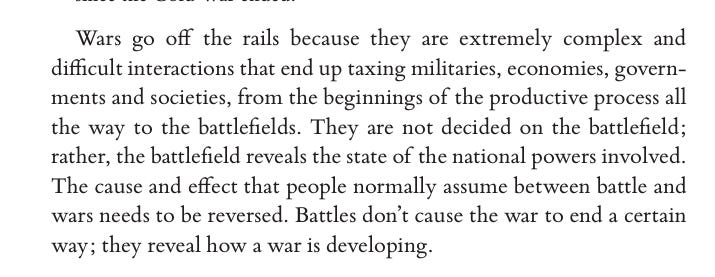
Not understanding this is one of the reasons the reporting about the fighting in Ukraine was so weak for so long. For example, looking at the Battle of Pokrovsk, which raged from 2024 throughout most of 2025, it is easy to see that the result was not decisive in any way. Russia’s ability to gain control of the wrecked shell of that city is and was not important strategically. It made no difference to the continuing creation of military power on either side, and deprived neither side of, nor gained for either side, access to the key resources or political power needed to keep waging war.
However, what the Battle of Pokrovsk did, if you were paying attention to the right things at the right time, was reveal how the Russo-Ukraine war was developing. That was, not necessarily in Russia’s favor.
