Can You Do Regime Change Without Changing A Regime?
The Monroe Doctrine was not "F&ck Around And Find Out"; Marco Rubio's Last Chance

Hi All,
The Trump administration certainly poses fascinating intellectual challenges to scholars of foreign relations. For instance, can you discuss serving the “national interest” if you are weakening the foundations and international position of the nation? When it comes to the intervention in Venezuela it has posed us with a particularly fascinating conundrum.
Can you do “Regime Change” without changing a regime?
Because that seems to be precisely what the USA has done with Venezuela. When the intervention was first announced on Saturday, followed close on with the fist-pumping, flag-waving announcement that Venezuelan dictator Nicolas Maduro had been seized, it seemed regime change was coming. President Trump even boasted at the press conference that evening that the USA was now “in charge” of Venezuela and would determine policy for that country from now on into the foreseeable future. The air was thick with hubris—which has continued to today.
However, in Venezuela istelf, the regime change stopped as soon as Maduro was captured. Maduro’s successor turned out not to be the person who probably won the 2024 Venezuelan election, Edmundo Gonzalez, or the leader of the strongest opposition movement in Venezuela, the recently named Nobel Peace Prize Winner, Maria Corina Machado. Either of them could make claims for legitimacy in regime change and would have represented a break from the Maduro regime.
No, it seemed that the USA was content to see power transferred from Maduro to the rest of Maduro’s government and military infrastructure. Trump spoke surprisingly positively about Maduro’s Vice President, Delcy Rodriguez (who previously identified as far left/Marxist). She was subsequently sworn in and promised to keep on with Maduro’s policies.
Now there is a struggle for power in Venezuela still ongoing. The other claimant to the throne, however, is not an opposition figure, but reportedly the Minister for Justice, Diosdado Cabello Rondon. Rondon, btw, would be if anything more ruthless than Maduro—someone I spoke to with dealings with the Venezuelan government said he would almost certainly be “worse”. He has been accused by the US government of being a key figure in drug trafficking.
So getting rid of Maduro has left power in the hands of a communist or a drug trafficker (if the US is to be believed) or both. Not only that, the old players who were wielding power behind the scenes are still there and have not been materially weakened. Though the US has huffed and puffed, there are still 30,000 or so Cubans in Venezuela and the cartels still maintain their influence. Also, the Chinese and Russians are still there, and it was notable that when Rodriguez was sworn in that one of the first things she did was embrace the Chinese and Russian (and Iranian) ambassadors.
In other words, the Maduro regime is reconstructing itself without Maduro and there is no indication that it will be better for the Venezuelan people. And, tbh, the USA is now in a worse position to influence policy. It has done its military operation (and many of the SF units seem to have subsequently redeployed out of the region) and has no troops in Venezuela. If the Trump administration decides it cannot live with the Madurists, its options are now more limited. It can invade the country and permanently base troops there (yikes), or it can keep abducting leaders until it ends up with one it likes. Neither of these options are particularly palatable.
And maybe that was the purpose all along. It seems clear now that the charges of drug running were a pretext all along. The US government just quietly admitted that the drug cartel that they claimed Maduro helped run, the Cartel de los Soles, does not actually exist. Trump seems far more interested in seizing control of the oil reserves—but even that is something that is beyond the US. It will take years, perhaps decades, before the US would be back invested in the Venezuelan oil business. Who knows what the politics will be then.
The USA will, I fear, find out once again that it is not as powerful as it thinks it is. Bombing Iran did not lead to regime change and seizing Maduro will not as well.
So what do we have? We have the US government going to great lengths to basically keep the present Venezuelan regime in power. In other words, regime change without changing regimes.
It certainly is a novel way of doing business.
Note: if the USA really wanted regime change, they could have pushed for Machado to take power—but the opposite has happened. Trump insulted Machado in his press conference and it has been reported that he will never support her because she received the Nobel Peace Prize and he did not. That was in a Washington Post story, and Machado said a few hours ago that Trump has refused to speak to her since she accepted the prize. Below from a Reuters story.
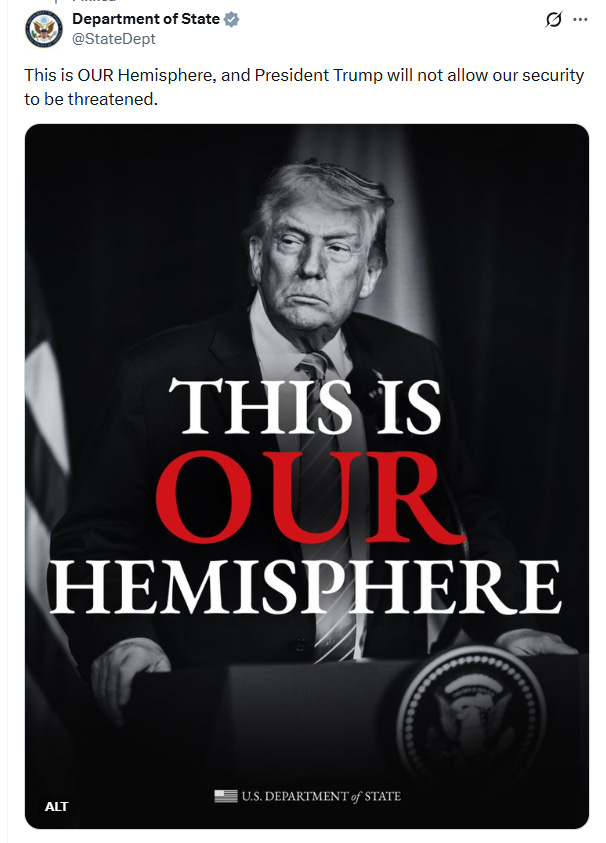
The Monroe Doctrine Was Never Just: “F&ck Around And Find Out”
One thing that really bugs me as a historian of US foreign policy, and a critic of realist thinking, is the lack of understanding of the historical meaning and progression of the Monroe Doctrine.
